



1 | INTRODUCTION
Digital fashion, the creation and use of clothing solely in the virtual space, has gained significant momentum in recent years. Rapid transformation is nothing new to the fashion business. The advent of e-commerce presented the industry with an unprecedented challenge at the turn of the 20th century, fueled by the COVID-19 outbreak, as the contactless culture was promoted to curb the spread of the virus (Ganichev & Koshovets, 2021). Before the outbreak of COVID-19, fast fashion was leveraging new technologies to promote growth in the fashion business. Despite the devastating pandemic, life had to go on, which required people to adopt alternatives during this tough time, this provided an opportunity for the growth of digital fashion. The sudden shift towards digital technologies became a key differentiator in the fashion business, as people could not visit traditional brick-and-mortar fashion stores to buy clothes.
Despite the effect being more pronounced due to the COVID-19 pandemic, the digital revolution in the fashion sector can be traced back to the late 20th century, going into the early 21st century (Boughlala & Smelik, 2024; Jin & Shin, 2021). In the late 1990s, we saw the rise of e-commerce in fashion with the establishment of various online stores that enabled consumers to purchase clothing online. The 2000s saw the emergence of social media platforms such as Facebook, which played a key role in the development of digital fashion marketing (Ayesu et al., 2024). Further developments in technology ushered in the new concept of the metaverse driven by the advancements in virtual reality (VR), augmented reality (AR) artificial intelligence (AI) and blockchain (Soliman et al., 2024). The term metaverse is associated with science fiction writer Neal Stephenson who predicted the virtual world which he referred to as the "metaverse" in one of his novels Snow Crash, in the year 1992. In the science fiction novel Snow Crash, Stephenson described the metaverse as a sun-filled virtual environment, which provided a respite from the miserable actual world (Mu et al., 2024). Snow Crash inspired software developers in the year 2003 to create “Second Life”, an online platform through which users could create avatars of themselves and interact with others through virtual spaces, thus giving attention to the concept of “metaverse” (Hollensen et al., 2023). According to Laeeq (2022), the metaverse can be defined as the concept of a fully immersive virtual world where people gather to socialise, play, and work. Similarly, Luong et al. (2024) defined the metaverse as a virtual environment where users, most commonly Gen Z, explore, communicate, play, and exchange goods.
Despite the nascent stage of the metaverse in the fashion industry, Generation Z is increasingly engaging with various online platforms as evidenced by the purchase of digital fashion on various metaverse platforms. The world's first digital garment fetched USD 9,500.00 proving that digital fashion products can change the market dynamics in the world of fashion (Ramesh, 2022). This prompted fashion brands to join the new fashion sector as it promised great returns. To speed up its digital transition in the metaverse, Nike purchased RTFKT, a business that makes virtual footwear and digital artefacts, in 2021 (Park & Lim, 2023). Nike forecasted the trends in virtual spaces, hence decided to purchase RTFKT as it had expertise in digital collectables and virtual fashion to provide its customers with an intersection of sports, creativity, gaming and fashion. Fashion brands such as Gucci, Ralph Lauren, Polo, Zara, and H&M have also set up online shops on the game platform Roblox to offer apparel and accessories exclusively available digitally (Edelson, 2023; Kim & Noh, 2022). These fashion brands have turned to the metaverse to engage digitally native consumers, as it offers them opportunities for new revenue streams and enhances brand innovation. Gucci’s NFT-based collections and virtual handbags have sold for higher prices than physical counterparts, proving that digital fashion is a potential income stream for these brands (Joy et al., 2022). Within the new developments in digital fashion, the metaverse is positioned as the next frontier for social interaction and commerce.
The fashion industry ranks second after the petroleum industry in terms of its waste contribution to the environment (Chand et al., 2023; Dicuonzo et al., 2020; Niinimäki et al., 2020). Consumers are also becoming aware of the role they play in taking care of the environment, thus they are opting for eco-friendly products (Tran et al., 2022). Digital fashion promotes circularity in the fashion business as the digital apparel developed in the metaverse benefits customers and the environment, thus promoting sustainable fashion consumption (Varshney & Chaudhary, 2024). As technology is advancing, more fashion companies or firms are experimenting with artificial intelligence (AI), gaming, augmented reality (AR), 3D printing, 3D computer-aided design (CAD) and expanding into the metaverse, thus making digital fashion even more complicated than ever. AR enables users to see digital outfits on themselves in real-time via their phone or AR glasses. Brands such as Gucci use AR in its interactive digital fashion platforms. AI in fashion design is increasingly becoming more important to designers as online platforms such as NewArc.ai and Raspberry AI allow designers to quickly come up with digital design outputs that can be easily shared and translated into production. In fashion retailing, AI is also used where chatbots help customers in purchasing fashion products both physically and online (Grewal et al., 2017), though Pantano and Pizzi (2020), argue that chatbots have problems with language translation. Despite the language issues, fashion retail chatbots are being used as digital sales associates, as they can guide customers to relevant products based on their preferences and shopping history. AI and machine learning can be used to forecast fashion trends by analysing data extracted from social media, influencer fashion styles and clothing consumption patterns. Digital fashion technologies have also influenced a change in fashion communication and marketing strategies, with the majority of businesses and brands adapting their operations using this sector-specific strategy. Additionally, these technologies have an impact on culture and society, changing how design is approached as well as the ways that art is created (Casciani et al., 2022). These digital technological advancements have provided a fertile ground for the acceleration of e-commerce in the fashion world.
In the global fashion business, fashion weeks play the crucial role of connecting designers, buyers, models, celebrities and fashion fanatics. These events serve as platforms for showcasing new collections, setting trends, and celebrating creativity in the fashion industry (Geissinger & Laurell, 2018). As the COVID-19 pandemic spread across nations in 2020, fashion weeks planned for New York, London, Milan, Shanghai, and Paris had to be cancelled. But, as the fashion industry was already in the digital era transition, it was easy for the sector to leverage new technologies, resulting in virtual catwalks for the various fashion weeks (Silvestri, 2022). Similar to the previously held fashion weeks, the concept of Metaverse Fashion Week (MVFW) was born out of the increased integration of fashion with digital and blockchain technology. The first-ever digital fashion week featuring avatar models and animated runways, dubbed the MVFW, was held from 23-27 March 2022 on a virtual property owned by Decentraland (Michelle & Sabrina, 2024). During the MVFW, digital fashion products are exhibited virtually and viewers are allowed to buy both the digital and physical garments from the sample digital presentations. One of the key benefits of digital or virtual fashion exhibitions is that they allow upcoming designers to reach a wider audience quickly, thus they can build their brands easily (Vrencoska, 2015). According to Jana (2022), digital designs are not yet comparable in earnings to physical clothing but the metaverse presents a potentially lucrative market for fashion for fashion designers and fashion companies. Fashion brands Louis Vuitton, Gucci, Ralph Lauren, and Balenciaga have invested in the metaverse through video game skins as they seek to get a new community of consumers. These brands have invested in the creation of Non-Fungible Tokens (NFTs) and virtual garments one can wear in different virtual universes (Bringé, 2022). NFTs are online blockchain traded rights through the metaverse and they can be anything digital like a song, virtual fashion, images, or a virtual character (Dowling, 2022). In terms of the security of these digital assets, blockchain technology underpins the existence of the metaverse, so every item of your design work is unique and will not be duplicated. To increase the worth of their fashion collections, fashion companies and or designers can combine their physical and digital collections resulting in "phygital" fashion.
As technology is advancing, the geographical divide is becoming obscured in various industry sectors, including fashion. In the fashion industry, the COVID-19 outbreak pushed people to adopt these technologies. Though there is a lot of philosophical discussion between fashion and the metaverse in both practice and academia, the fashion designer's perspective and experience in the metaverse receive less attention. This makes it clear that we need to learn more about how new fashion creators experience the metaverse. These intertwined innovations present profound implications for the fashion industry, especially for emerging designers who seek to carve out unique spaces in an increasingly competitive market. The study aims to unpack how these emerging fashion designers see themselves fitting into this growing industry and their experiences in taking part in digital fashion and the metaverse. This study looks at the present state of digital and or virtual fashion design from an emerging designer’s perspective.
1.1 | Metaverse in developing economies
The adoption of metaverse technologies in developing economies is hindered by limited digital infrastructure UNESCO, 2023. However, the increasing penetration of smartphones and internet connectivity creates opportunities for widespread adoption. Fashion brands are leveraging these advancements to create immersive experiences, such as virtual try-ons and personalised avatars, which drive consumer engagement
(Prashar & Prashar, 2024). Blockchain technology has been instrumental in the metaverse by facilitating the production and exchange of Non-Fungible Tokens (NFTs). Worldwide fashion brands are using NFTs to authenticate their digital fashion items, ensuring ownership and scarcity. This technology is particularly beneficial for small and medium-sized enterprises (SMEs) in developing economies, as it provides a secure and transparent platform for conducting transactions
(Trujillo & Bacciu, 2023). Recently, fashion experiences in the metaverse have been personalised through the use of artificial intelligence (AI) and machine learning
(Nair et al., 2024). These AI algorithms analyse consumer preferences to recommend digital fashion items, while machine learning models predict trends and optimise supply chains. All these technologies are enabling fashion brands to offer tailored experiences, increasing customer satisfaction and loyalty
(Mu et al., 2024). The digital divide remains a significant challenge for developing economies as access to tools for metaverse participation among fashion designers is not readily available.
Bhorat et al. (2023) reports that in Africa and other developing economies globally, the limited access to advanced technologies, such as VR headsets and high-speed internet, hinders the widespread adoption of metaverse technologies. Addressing these inequalities is essential for ensuring equitable participation in the digital economy.
Tiwari et al. (2025) opines that the lack of clear regulatory frameworks for the metaverse also poses challenges for businesses and consumers alike. As such, governments in developing economies must establish policies that promote innovation while safeguarding consumer interests, as this promotes virtual spaces development.
1.2 | Digital fashion in Africa
The digitalisation of the fashion industry has significantly broadened growth prospects for African designers, allowing those previously restricted by narrow domestic markets to access a substantially larger regional and international clientele without relocating
(UNESCO, 2023). During the COVID-19 outbreak in 2020, the Congolese-born fashion designer Anifa Mvuemba became the first African fashion designer to host a 3D virtual catwalk showcasing her designs under the Hanifa brand
(Segran, 2020). Despite her being based in the United States of America, her virtual catwalk products were inspired by her native country (Congo) hence the show became popular among many African fashion enthusiasts. The Nigerian start-up Thrill Digital has managed to create its own metaverse platform named Astra, which allows users to play crypto games, NFT shopping and attend virtual events
(Dayo, 2022). Their fashion metaverse platform is still being developed so that it can allow people to purchase fashion products as NFTs and also give them the option to get them as physical products in real life. This is similar to the results of a study focusing on the developments in the fashion industry in the global south by
Ogunyemi et al. (2023), which highlights that a shift to digital adoption in this sector is slow despite its benefits. Authors
(Muturi, 2024;
Osei & Bosro, 2024) highlight that emerging fashion designers in Ghana, Kenya, and Nigeria have adopted the use of digital social media platforms such as Facebook, TikTok and Instagram to promote their work. In South Africa, in addition to being active on the social media platforms, fashion designers have embraced hybrid events, which combine digital and physical components
(Onyekwelu, 2024). Other fashion designers, such as Percy Nii Okine from Ghana, have also embraced 3D virtual garment design and his virtual designs seek to promote the African story through virtual fashion
(Barnes, 2020). Despite the benefits of being active in virtual spaces, most African designers find it difficult to embrace these, as it requires investment in training and technologies.
1.3 | Theoretical Model
Consumers accept new products or services if they see real benefit or value in acquiring new ideas. Technology has been met with resistance in various industries as people feared the loss of jobs, but on the other hand, it has also created numerous opportunities that need to be capitalised on. The Unified Theory of Acceptance and Use of Technology (UTAUT) (Venkatesh et al., 2003) is regarded as one broad model that explains how technology is accepted by users. According to the UTAUT model, before adopting or using a particular technology, a person evaluates its performance expectations, effort expectations, societal impact, and enabling circumstances (Venkatesh et al., 2003). The Extended Unified Theory of Acceptance and Use of Technology (UTAUT2) (Venkatesh et al., 2012) is an extension of UTAUT and it expands on the latter by adding that hedonic motivation, monetary worth, and habit are novel factors that influence people's use of technology. Fashion and the metaverse are more concerned with customer experience, hence the adoption of the Extended Unified Theory of Acceptance and Use of Technology (UTAUT2) as proposed by Venkatesh et al. (2012) as shown in Figure 1. Fashion designers have to come up with digital and virtual products that can be traded on the metaverse as fashion brands seek to grow their businesses. The hedonic motivation in technology acceptance has seen more people from the younger generation playing a part in luxury fashion purchases. Fashion designers with an interest in virtual spaces have to produce well-designed and intriguing products for the audience to enjoy.
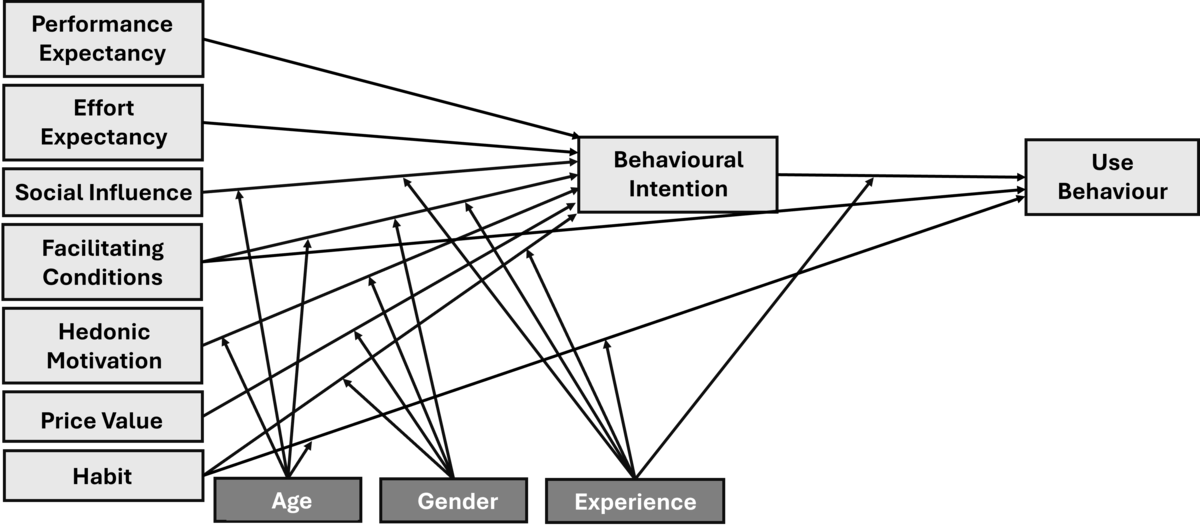
Figure 1.
UTAUT2 model
(Venkatesh et al., 2012)
For emerging fashion designers in Zimbabwe, digital fashion and the metaverse present new opportunities to showcase, create, and sell virtual clothing. The adoption of these technologies can be further explained using UTAUT2 as follows:
Performance Expectancy: Emerging fashion designers may perceive digital fashion and the metaverse as beneficial for reaching the global market, reducing production costs, and experimenting with innovative designs. If these designers believe these technologies improve their business growth and competitiveness, they are more likely to adopt them, similar to the view of Okine, a digital fashion designer from Ghana (Barnes, 2020).
Effort Expectancy: The ease of learning and using digital fashion tools (such as CLO 3D, Blender, CorelDraw or Decentraland) will influence adoption. If the platforms are intuitive and accessible, fashion designers will be more willing to engage.
Social Influence: Digital social media platforms, peers, influencers, and successful fashion entrepreneurs who embrace the metaverse may encourage the emerging Zimbabwean designers to do the same. Endorsing digital fashion by institutions of higher learning also has a direct impact on the adoption by consumers. This is also supported by Ayesu et al. (2024) as they emphasise that African fashion designers need to invest in social media as it has become an important tool in driving business growth.
Facilitating Conditions: The availability of resources, such as high-speed internet and access to the requisite digital fashion tools, impacts the adoption of metaverse technologies. These conditions are met with challenges, especially from a developing economy context, as stated in the UNESCO (2023) report.
Hedonic Motivation: The excitement derived from exploring the virtual spaces by the fashion designer when they experiment with new forms of self-expression can also drive the adoption of digital fashion by these designers.
Price Value: The cost of accessing digital fashion tools and metaverse platforms is a critical factor. If the perceived value outweighs the costs (for example, designers generating more revenue from NFTs or virtual clothing sales), adoption will increase such as in the case of Gucci (Joy et al., 2022).
Habit: The more the fashion designers engage with digital fashion tools and the metaverse, the more likely they are to continue using them. Frequent exposure and integration into daily design tasks reinforce adoption.
2 | METHODOLOGY
2.1 | Research Design
This study adopted a qualitative research methodology to investigate the experiences, attitudes, and knowledge of emerging or upcoming fashion designers who participated in a fashion exhibition event themed
Fashion Forward,sponsored by the British Council in Harare, Zimbabwe. The event targeted emerging fashion designers and challenged them to explore how they could use technology as leverage to build their fashion brands. The study focused on extracting meanings from the experiences of emerging designers
(Creswell, 2019), in their various projects that sought to explore fashion and the metaverse and how they managed to utilise technology in designing fashion products in their virtual spaces.
2.2 | Study Population and Sampling
The study population consisted of all emerging fashion designers who were the final entrants to the
Fashion Forward exhibition event. The event had 12 individuals who qualified to display their work as the chosen finalists who met the expectations set out by the sponsors of the event, the British Council in partnership with two other technical partners. Five participants were purposively sampled from the total group to participate in the in-depth interviews. The
Fashion Forward exhibition was targeted to showcase talent from emerging fashion designers, with a main emphasis on those who could digitally package their fashion story so that it could be further developed into a bigger product where the designer could seek ways to monetise it. The study adopted the use of five interview participants as digital fashion is still in its infancy in Zimbabwe, as evidenced by the number of entrants who applied to showcase their work during the
Fashion Forward event. This is also supported by
Ahmed (2025) who argues that the goal of a qualitative study should be to collect rich and meaningful perceptions. Similarly,
Creswell and Poth (2023) support the adoption of between 5-10 interviewees for focused studies that seek to explore a deeper understanding of the participants’ lived experiences. The key objective of the in-depth interviews was to explore the experiences of these emerging designers as they created their content in line with the global trends where fashion is going digital, so that further improvements could be made for designing future digital immersive environments.
2.3 | Methods for Collecting Data
Focus group discussions (FGD) and semi-structured interviews were used to collect data from the participants. The focus group discussion was done with a purposively sampled group of visitors who attended the Fashion Forward exhibition event. The chosen format in selecting participants was informed by the impact the participant could have on the discussion (Krueger & Casey, 2014; Nyumba et al., 2018). The questions for the discussion were shared with all the participants before the day of the actual event. The researchers played the leading role in the discussions and moderated to create a conducive environment so that participants could freely express themselves (Basnet, 2018). Otter.ai, a tool that summarises, transcribes and generates notes, was used during the focus group discussions by the researchers as it provides a quick summary.
Five in-depth one-on-one interviews with the emerging fashion designers were conducted on the day of the event. The interviews took an average time of thirty minutes, with the highest being forty minutes. The questions for the interview were grouped into four areas, namely, general understanding of digital fashion, understanding of the metaverse in fashion, the designer’s role in digital fashion and the metaverse, and experiences in digital fashion and the metaverse. Open-ended questions were used to allow the participants to fully express themselves and also to allow for further probing on aspects that could need more elaboration, thus making the interviews more accommodating and flexible
(Bryman, 2016).
2.4 | Ethical Considerations
Each participant had to sign a consent form before the interview and was given a chance to choose the time slot that suited them and also informed that they could withdraw from participating in the study at any time
(Ciuk & Latusek, 2018). All the interviews were audio-recorded and transcribed, and any information that could identify the participant was removed
(Creswell, 2013).
2.5 | Data Analysis
Thematic analysis, a technique that methodically finds and arranges patterns of meaning within qualitative data, was used to analyse the data from focus group discussions and interviews. The study followed the six-step method of systematic thematic analysis, which begins with the familiarisation of data, identification of keywords, selection of codes, theme development, and finally, the narrative construction (Naeem et al., 2023). Key themes included experiences of the fashion designers in various virtual and metaverse spaces, collaborative design and challenges in developing digital content for the metaverse. Thematic codes were developed through a systematic process which included the following steps.
Data Collection and Familiarisation: Before coding, data were gathered through qualitative techniques, namely in-depth interviews and focus group discussions. Data was captured from interviews with emerging Zimbabwean fashion designers discussing their views on digital fashion, the metaverse, and its impact on their industry.
Initial Coding: The researchers began with manual open coding, assigning short labels (codes) to segments of text that were deemed meaningful to the study. These codes were descriptive, summarising key points, such as "lack of digital infrastructure," "opportunities for global exposure," or "high cost of digital tools".
Axial Coding: Similar codes were then grouped into broader categories that captured common ideas. For example, codes like "limited access to technology", "slow internet connectivity" and "high software costs" were grouped under the category "Challenges in Digital Adoption".
Identifying Emerging Themes: The researchers then synthesised categories into overarching themes. These themes contributed to a better understanding of Zimbabwean fashion designers' ideas on digital fashion and the metaverse.
Refinement and Interpretation: The themes were then reviewed for coherence and relevance to the research question. Supporting illustrative quotes from interviewees and the focus group discussions were selected to highlight each emerging theme. The researchers reflected on the implications of the findings in relation to existing literature and the local fashion industry
.
2.6 | Ensuring trustworthiness
To enhance the findings, credibility, transferability, dependability, and confirmability, the following methods were used:
- Triangulation: Data was collected using two methods, namely semi-structured interviews and focus group discussions. The use of Otter.ai during the data collection and adoption of a team of researchers also assisted in reducing investigator biases. Using these multiple data sources helped to cross-check information, thus minimising the influence of personal or methodological bias. In other words, the study adopted data and investigator triangulation.
- Member checking: All the interview participants were given a pre-publication copy of the research results so that they could ensure their responses were correctly captured.
- The researchers also kept a research journal to provide an audit trail, which included detailed records of all research decisions and activities.
3 | RESULTS AND DISCUSSION
Face-to-face interviews with five emerging fashion designers were used to gather data on the designers’ perceptions of digital fashion and the metaverse, as well as their experiences and challenges in creating digital fashion content. The focus group discussion with eight participants sought to extract data about the experiences and insights from the visitors as they had an opportunity to interact with the fashion designers. Data from face-to-face interviews with fashion designers and focus group discussions with visitors revealed the following themes:
3.1 | Digital content knowledge and education
Fashion designers revealed that their knowledge of digital content creation was not acquired through formal education. The COVID-19 lockdown motivated fashion designers to look for alternative ways to earn a living. Digital content creation became a key attribute during the lockdown period, thus forcing many people to self-teach themselves in various skills they could learn online. The COVID-19 epidemic also accelerated the adoption of digital tools in education, compelling fashion design programs to transition to remote teaching methods. This shift highlighted the necessity for educators to incorporate digital tools effectively into their curricula to maintain the quality and engagement of practice-based learning
(Ogunyemi et al., 2023). The internet was cited as the major source of inspiration and education by the fashion designers, as they gained knowledge from various websites. The focus group discussions revealed that most of the visitors to the
Fashion Forward event were fashion designers who got inspired by what other designers were doing in digital fashion design.
Boughlala and Smelik (2024) also highlight that during the COVID-19 breakdown, digital fashion became popular and people invested more of their time on the internet learning how they could use it to share their design ideas. The discussions revealed that most visitors learned about digital fashion at this event, though they are fashion design students at their respective institutions of higher learning. Table 1 gives examples of sub-themes generated under the major theme and the corresponding illustrative quotes.
Table 1. Designers’ Knowledge of Metaverse and Virtual Spaces
| Sub-Theme | Description | Illustrative Quote |
| Basic Knowledge | Covid-19 pandemic forced the cancellation of physical fashion events | “I had to look for alternative ways to market my fashion brand during the pandemic. The Congolese-born fashion designer Anifa Mvuemba became my source of inspiration after viewing her virtual catwalk” |
| Online self-taught skills | Online platforms as sources of inspiration and education | “Online design platforms such as Behance and 99design contest inspire me to improve my CAD skills in fashion” |
Social media platforms played a major role in promoting virtual spaces, as highlighted during the focus group discussions. Participants highlighted that
TikTok and
Instagram were the major sources of digital fashion content as designers worldwide sought audiences during the pandemic. Online platforms that bring together designers, such as
Behance where fashion designers keep their portfolios also became sources of inspiration and education for the designers. Forums or chat rooms on these platforms allow designers to share information, thus allowing designers to learn about new software or hardware in the virtual spaces. While the integration of digital content in fashion education presents numerous opportunities, it also poses challenges, as supported by
Ueno et al. (2024). Educators must balance the acquisition of technical digital skills with the preservation of traditional design principles. Furthermore, fostering fluid and modular thinking, as well as effective communication skills, becomes crucial in a digital learning environment.
3.2 | Collaborative design (co-design/co-creation)
Under this theme, the emphasis is on the need for collaborative efforts from various players in the fashion business to promote virtual spaces for fashion. Fashion designers, game developers, fine artists, brand managers, and animators were highlighted as key in the development of virtual content and virtual spaces. Through co-design and co-creation, fashion designers argue that it brings out a creative output that can have a huge impact on the market. Table 2 highlights the sub-theme with its corresponding illustrative quotes from the designers.
Table 2. Collaboration in developing virtual spaces and content
| Sub-Theme | Description | Illustrative Quote |
| Co-design in virtual fashion | Need for collaborative efforts in developing digital content to promote African culture through fashion | “Game developers, fine artists, and fashion designers in Africa should collaborate to design and create digital content that promotes aspects such as African culture and African print” |
| Co-creation in virtual fashion | Fashion retailers are not investing in virtual fashion | "Fashion retail giants should play a leading role in promoting virtual fashion through sponsoring virtual events and also create virtual spaces that can be easily accessed by the local fashion designers" |
From the discussions, the visitors also agreed that fashion retailers could partner with local fashion designers in forecasting fashion trends that could be marketed through the metaverse. The discussions also revealed that fashion retailers can collaborate with designers to develop virtual try-on technologies in the form of mobile phone applications and in-store applications that can market fashion brands easily to consumers. It was further highlighted that these brands could then be duplicated on the metaverse to increase brand visibility.
3.3 | Virtual spaces and metaverse
Interview participants revealed that they had used different virtual platforms to curate their digital fashion projects (Table 3). Among the metaverse platforms that the participants cited were Cosplay, Roblox, and Spatial.
Table 3. Virtual spaces and metaverse used by the designers
| Sub-Theme | Description | Illustrative Quote |
| Source of Inspiration | Use of nature as an inspiration to develop products for the virtual world (Seven Wonders Collection) |
“My collection is inspired by the seven wonders of the world, and would like to collaborate with a game developer to create the seven virtual worlds. My wish is to monetise the idea through various outfits suitable or inspired in those seven virtual worlds”
|
| Knowledgeability and Education | Designers exhibited knowledge of metaverse platforms |
“I have designed two fashion items on Cosplay and have created my space on Spatial, which I am still developing”
|
|
Sustainability through digital fashion |
Designers are keen to promote sustainable fashion consumption |
“To promote sustainable consumption of fashion the QR code shares intangible heritage about the Batonga tribe and the accessories used on the digital outfits through a virtual space” |
|
Virtual exhibitions |
Use of different platforms |
"I tried Spatial for a virtual exhibition of my first digital fashion collection. The 3D environments are stunning, and it feels like an actual fashion gallery where people can explore my designs" |
3.4 | Challenges in digital fashion
To develop digital content that can be used in various virtual spaces and or the metaverse, the designer needs to acquire the knowledge first. Due to a lack of a formal educational setup where designers learn to utilise these digital platforms, it is difficult to fully maximise opportunities proffered by the metaverse. The global fashion industry is changing due to the emergence of digital fashion and the metaverse, which is opening up new avenues for consumers, designers, and companies. However, emerging economies face many obstacles to the uptake and expansion of these advances. These challenges (Table 4) stem from technological, economic, social, and infrastructural limitations that hinder the seamless integration of digital fashion and the metaverse into mainstream fashion industries.
Table 4. Challenges in virtual spaces and metaverse
| Sub-Theme | Description | Illustrative Quote |
| Knowledgeability and Education | Designers face challenges in using the virtual platforms | “To develop digital fashion designs, one needs a lot of time to learn various technologies and how these can be used together with various platforms such as Roblox and Cosplay” |
| Consumer Experience and Engagement | Consumers are not aware of digital fashion and are afraid of getting scammed through NFTs | “I am not comfortable making payment using these new digital currencies and I have heard people who lost money and cannot trace it back” |
| Financial limitations | Designers do not have equipment to use for digital fashion development | “Due to financial challenges young emerging fashion designers cannot purchase good hardware and software required for developing virtual fashion” |
It was also revealed through discussions, that aspiring young fashion designers lack simple gadgets like a laptop that could help them in creating digital fashion products. Phobia of technology and ignorance were also cited as other factors that could be hindering the development of the digital fashion industry in general. Many people are not familiar with digital fashion concepts, blockchain technology, and non-fungible tokens (NFTs), which are essential in the metaverse fashion ecosystem. Without adequate digital education and awareness, it becomes difficult for individuals and businesses to participate in this new digital frontier. Luong et al. (2024) opines that this challenge makes the adoption of digital fashion a challenge. The regulatory landscape for digital fashion and the metaverse is still evolving both in developed and developing countries. This then requires proper regulatory frameworks to be crafted to protect the consumers and the fashion designers from losing their money or design efforts through counterfeits or piracy. Fashion designers in emerging economies, therefore, need to lobby their governments to enact intellectual property laws for copyright protection and data privacy, as piracy is common in developing economies. The cost of developing and accessing digital fashion assets is another significant barrier in emerging economies. Creating digital fashion items also requires specialised software, skilled designers, and advanced technology, which can be expensive for the emerging fashion designer. The metaverse and digital fashion heavily rely on blockchain technology and digital currencies, which require financial inclusion for seamless transactions, as supported by Joy et al. (2022) and Varshney et al. (2024). However, many developing economies still have large unbanked populations with limited access to digital payment systems. This lack of financial infrastructure and trust in digital currencies further hinders the growth of digital fashion in these developing economies.
4 | DISCUSSION OF FINDINGS
From the results presented, it is clear that education on digital fashion and its development is required. The current situation is motivated by the fashion designers themselves, and given the challenges they face, it is important to design content that can be taught to fashion designers in institutions of higher learning so that they also participate in the metaverse. The metaverse can also be used as a medium of instruction in educational setups, as supported by Ueno et al. (2024) as it is learner-centred. The best way to fully explore the metaverse in higher education is through collaborations with the already established metaverse companies, like the Parsons School of Design in New York, partnered with Roblox (Azmat, 2023). Social media can be used for marketing the fashion designers’ work through live shows that can be streamed on various social media platforms. Marketing the designers’ work on social media can also result in more traffic to their metaverse, and this will increase the visibility of the brand as also supported by Fakhry and Nasr (2023). According to the UTAUT2 model (Venkatesh et al., 2012), social media influence plays a crucial role in the adoption of digital fashion, and this view is also supported by Ayesu et al. (2024). The study also confirms that fashion designers are more aligned towards “phygital” where they are designing fashion items both physically and digitally. Fashion designers prefer to have the actual product physically to test its functionality, citing that digital designs in some cases, may not be functional. This can be attributed to the fact that these designers are more exposed to the physical world of design rather than the digital world of design. One of the benefits of phygital design is that a garment one purchases virtually from the metaverse can also be supplied physically. This allows the designer to earn more as they earn from the virtual space sale and also earn through the sale of the physical garment, authors (Sabir, 2022) and (Bringé, 2022) also state that some popular brands have already adopted this method to increase their revenues from their metaverse and physical stores. The study revealed that technology is key in the development of digital and virtual spaces, and according to the UTAUT2 by Venkatesh et al. (2012), consumers have a bigger role to play. Virtual spaces and social media platforms where consumers can provide feedback about the fashion brand or product, therefore, become key. Digital developments in the fashion industry have removed geographical barriers and promoted seamless learning for everyone who has access to technology. The results also reveal that the metaverse can be a good source of income for those designers who can develop their avatars in the virtual space and such avatars can generate income for the designers. Metaverse platforms like Roblox, Spatial, Zepeto, and Cosplay can act as good virtual spaces where fashion designers can earn income and increase brand loyalty through digital ownership of NFTs. Collaboration in creating virtual spaces and digital content is also important, as experts can combine their efforts through co-creation and co-design. Co-design and co-creation also promote the sharing of ideas among the designers and provide an opportunity for designers to share their lived experiences with different software and virtual spaces. The metaverse creates new avenues for design as fashion designers can experiment with virtual clothing and accessories, allowing for limitless creativity without the constraints of physical materials (Khanal, 2024). The metaverse enables personalised fashion experiences through customisable avatars, enhancing self-expression and individuality for fashion designers.
The study highlights how digital fashion is changing the fashion industry as it promotes sustainability through waste reduction, energy efficiency, and ethical consumption. Digital fashion eliminates the need for physical samples and prototypes, reducing fabric waste in the design and manufacturing process (Casciani et al., 2022). Fashion products sold in the metaverse do not require shipping when a customer purchases the digital product through NFTs, hence it cuts down on fuel consumption and emissions, thus promoting circularity in the fashion business. In addition, digital fashion outputs such as virtual outfits (for social media, gaming, or metaverse wear) allow users to experiment with fashion trends without having to physically purchase and discard the garment. As supported by Soliman et al. (2024) the adoption of blockchain and NFT technologies in digital fashion promotes circularity as it ensures transparency and traceability in digital and physical fashion, thus preventing counterfeiting and unethical sourcing, which is common in the sector. Using AI and 3D modelling, fashion designers can easily create sustainable designs that can be evaluated easily using minimal resources, as various materials can be tested virtually before production of the actual garment. As the concept of circularity gains momentum in the fashion industry, virtual garments can be easily resold, transferred or repurposed across digital platforms without the need of physically making the garment.
Institutions of education play a crucial role in supporting the adoption of digital fashion by providing infrastructure, education, funding, and collaboration opportunities. This view is also shared with
Azmat (2023), who mentions that universities and fashion schools can integrate digital fashion into their curriculum, teaching skills in 3D modelling, virtual design, and blockchain technology or the successful adoption of the metaverse in fashion. These institutions can also offer workshops, certifications, and online courses to upskill fashion designers and professionals in the use of available digital fashion tools such as CLO 3D, Marvellous Designer, and Blender, as they can be expensive for them to access on an individual basis.
Michelle and Sabrina (2024) reported that governments in developing economies and private institutions can also provide grants, subsidies, or funding programs to support emerging digital fashion designers and start-ups. Additionally, financial support through venture capital programs with fashion design incubators can provide fertile ground for the development of innovative digital fashion brands, thus promoting their market growth. According to
Dayo (2022) Africa has the potential to grow its digital footprint in fashion as it can leverage on its cultural heritage to promote its distinct designs. Institutions of higher education in Africa can therefore partner with research labs in creating partnerships with fashion tech companies in research on digital fashion trends, sustainability, and technological advancements such as NFTs, AR/VR, and AI-driven fashion design. As supported by
Tiwari et al. (2025), governments and regulatory bodies need to develop policies that support the digital fashion economy, such as intellectual property rights for digital garments, as this smoothens the adoption of digital wearables among fashion consumers. Museums and galleries can also support the growth of digital fashion through showcasing virtual exhibitions and immersive experiences as this impacts how viewers adopt the metaverse.
5 | IMPLICATIONS OF FINDINGS
The metaverse has ushered in new problems in patenting and copyright issues as traditional patent laws focus on physical inventions, but many metaverse innovations challenge existing definitions (Krishna, 2021; Nair et al., 2024). Digital fashion is no exception, as people can copy or imitate the designs of others. The metaverse has empowered creative designers through blockchain technologies to earn income using various cryptocurrencies, which makes it easy for transactions. The study also emphasises education, as it is important for designers to know before they can fully try digital design. In emerging economies, fashion designers can approach the metaverse using the "phygital" way, where certain physical aspects are still required and blended together with the digital. Phygital fashion design can assist emerging designers in generating more income as they can benefit from the virtual comments to improve the final physical garment, which they can sell. The metaverse provides a fertile ground to prop up the upcoming fashion designers, as the opportunities are limitless. Due to the high rate of mobile phone penetration in emerging economies such as Zimbabwe, challenges faced by designers are slowly being overshadowed as more mobile phone applications and versions are being developed to promote virtual fashion.
6 | LIMITATIONS OF THE STUDY
Subjectivity in Qualitative Data: As the study is qualitative, its conclusions are based on the selected emerging fashion designers who expressed their personal experiences and views with regard to the metaverse and virtual fashion, which can be difficult to generalise for the whole population of emerging fashion designers, as there might be biases.
Sample Size: The study used a controlled group of fashion designers who had shown interest in participating in the fashion exhibition event only, therefore leaving those who might have been interested but failed to participate. The study sampled only five (5) out of the twelve (12) final participants of the Fashion Forward event, which might have an impact on the generalisability of the results to represent the views of other emerging fashion designers. The choice of five participants was motivated by the fact that the Fashion Forward event organisers made the initial selection of fashion designers who had shown knowledge of digital fashion and the metaverse. For the study, choosing a sample of 40% from the total number of designers was a fair selection to generalise the results, as it was also exploratory in nature.
Future studies might opt for using other research designs, such as mixing quantitative methods with qualitative methods. The study also only looked at emerging fashion designers, though another view that considers the more experienced designers could provide useful insights on issues related to digital fashion and the metaverse.
7 | CONCLUSION AND FUTURE STUDIES
The study concludes that digital fashion has outpaced the curriculum development, thus, institutions of higher learning have to quickly find ways of incorporating digital fashion and metaverse concepts into their curricula so that fashion designers are technologically empowered. Game development where the design team is made up of people who understand and appreciate all the key sectors is important. Co-design and co-creation are therefore important for developing virtual spaces and virtual content. Fashion designers and their teams can also learn from the already developed games on the metaverse on how they have packaged their products and developed a contextually appealing product that is easily understood by the target audience. The online presence of fashion designers has become key as this improves their brand visibility and can result in income generation through the use of blockchain technologies and cryptocurrencies that have made it easy for people to transact worldwide. Participation in events such as the Metaverse Fashion Week (MVFW) can also help emerging fashion designers reach a wider audience despite geographical boundaries, as it allows them to launch and market their digital fashion brands easily. Emerging fashion designers can adopt the “phygital” strategy to earn income from selling their products as digital assets and selling the actual physical garment. Despite the excitement, designers face challenges, such as navigating the complexities of digital rights and ensuring inclusivity in virtual spaces. The balance between digital and physical fashion remains a critical discussion point, as some argue that the essence of fashion may be diluted in a purely digital realm. In conclusion, digital fashion and the metaverse are part of the future of the fashion design industry, thus, all players need to embrace them as technological advances are happening at a faster pace.
ACKNOWLEDGMENTS
The authors would like to acknowledge the assistance of the British Council Zimbabwe during the data collection process.
ETHICS APPROVAL STATEMENT
The Ethics Committee at Chinhoyi University of Technology approved the set of questions before data collection started. Respondent was told about the purpose of the study; hence, his consent was taken before he proceeded to answer the interview questions. Also, the confidentiality and anonymity of respondents were assured.
CONFLICT OF INTEREST STATEMENT
The authors declare no conflict of interest.
DECLARATION OF GENERATIVE AI AND AI-ASSISTED TECHNOLOGIES IN THE WRITING PROCESS
During the preparation of this work, the authors used Grammarly for English editing. After using this tool, the authors reviewed and edited the content as needed and take full responsibility for the content of the publication.
ORCID
Walter Chipambwa
-
 https://orcid.org/0000-0002-1065-8530
Onismo S., Hahlani
-
https://orcid.org/0009-0001-4095-068X