



1 | INTRODUCTION
The term ‘Macramé’ originates from the term ‘migramah’, which refers to the craft of arranging rope in a manner that results in a practical and adaptable shape. Macramé involves the ability to intertwine two or more ropes or threads to create handcrafted items (Ibrahim, 2018). It is considered a hand craft because Macramé relies on manual dexterity to knot the ropes. The creation of Macramé involves mastering certain basic techniques, which are fundamental knots that can be applied to any Macramé project. These foundational techniques include Lark head knot, Square knot, Clove-hitch, Snake, Chinese and Half knots (Atika & Purwanti 2022). In Ghana, Macramé is taught in a few universities, including Kwame Nkrumah University of Science and Technology (KNUST). However, there has been limited research on the teaching methods and pedagogy surrounding macramé in general (Horst, 2013). The absence of standardised teaching resources contributes to inconsistencies in the teaching and learning of Macramé, leaving students to heavily rely on experiential learning without structured guidelines (Golden, 2000).
Macramé instruction is traditionally demonstration-based and hands-on, yet as student-to-teacher ratios increase, many students are left out during studio demonstrations
(Younse, 2012). Learners often struggle with visibility, retention of knotting sequences, and the ability to replicate demonstrated techniques, limiting their ability to develop mastery. Additionally, while Macramé requires precise material estimation, there is no standardised method for calculating cord length. This often leads to wastage or insufficiency of materials, which affects sustainability in textile education. Existing research has not addressed the problem of material inefficiency, and no mathematical formula has been introduced to standardise cord length calculations for Macramé production
(Marlina, 2020). The lack of research on Macramé teaching methods, material efficiency, and sustainability raises concerns regarding the effectiveness of current instructional strategies. There is a pressing need to integrate evidence-based teaching approaches that enhance learning outcomes, material sustainability, and instructional efficiency. The integration of a mathematical approach to cord length estimation can bridge this gap by reducing material wastage and optimising sustainability practices
(Issah, Ameyaw & Ibrahim, 2023). This dearth of literature or research in the area of Macramé is very concerning because evidence-based approaches are needed in the development of new teaching strategies. The study therefore seeks to improve on the teaching and learning of Macramé, ensuring accessibility and mastery for all and having a standardised mathematical formula to play a role in reducing material wastage and optimising sustainable goals.
1.1 | Concept of Education
Education is defined as the process carried out by older generations to prepare younger individuals for participation in society. It aims to instill and develop in young people the moral, intellectual, and physical qualities required by society and their specific environment
(Jubaer & Hoque, 2021). They view education as the socialisation of the younger generation
(Aheto-Tsegah, 2011). Subsequently, education might be comprehensively seen as how individuals figure out how to partake in the everyday routine of society, in which they experience the society in which they live
(Billett, 2011). In summary, education involves learning and acquiring the skills, knowledge, attitudes, and values necessary for individuals to be responsible and to contribute effectively to the development of their society.
1.2 | Pedagogies of Teaching and Learning
The role of teaching in education is increasingly acknowledged as a means to foster the capacity for integrating knowledge and establishing connections across various subjects
(Heywood, Parker & Jolley, 2012). While it's true that content knowledge and methods remain fundamental in teacher education, there is growing questioning of the assumption that they are the sole foundation for effective teaching. The relationship between theory and practice is another crucial aspect of a robust teacher education program.
Darling-Hammond (2006) observed that traditional teacher education often involves students completing batches of coursework in isolation from practical experience, with only a brief student teaching component at the end of the programme. While discussions about the structure of teacher education programmes have centred on traditional versus alternative approaches, it is crucial for promoting innovative teaching practices
(Webber & Miller, 2016).
LaVelle, Lovato, and Stephenson (2020) emphasise the importance of making learning activities enjoyable for students. In the realm of evaluation practice,
Patton's (2017) phrase "intended use for intended users" resonates strongly, and a similar approach applies to teaching pedagogy.
1.3 | Pedagogy in Teaching Macramé
Teaching Macramé requires concentration and the ability to learn specific skills, such as tying shoelaces. As a course linked to technical and vocational education and training (TVET), Macramé is a valuable addition to the Textile Education program in tertiary institutions
(Sintim, 2008). The curriculum for Macramé in the Department of Indigenous Art and Technology (IAT) has consistently emphasised the importance of student involvement in activities that facilitate teaching and learning, promoting a broader understanding of knowledge while fostering creativity and critical thinking skills in Indigenous Art and Technology (IAT) Course Content for Fibre & Fabrics, 2022/2023. Consequently, Macramé should be taught as a component in the Fibre and Fabrics course at all levels from Year One to Year Four in tertiary institutions. The course is structured to include various techniques and is integrated with other methods, aiming to equip each student with the necessary skills, knowledge, and training to prepare them for self-employment and enable them to train others as apprentices who may not have the opportunity to continue their education
(Ibrahim, 2018). Regarding the existing cord dimensions and appropriateness in achieving standardisation in Macramé, there are no known standard measurements. Except for the fact that the cords are wound onto flat boards for a certain amount of time to achieve some kind of appropriateness, it is based on guesswork.
Phillips (2013) states that the cord used for knotting is calculated by the length of the ends and measuring off, and making the cord 4 times longer than the piece to be knotted.
1.4 | Exploring Mathematical Formula through Craft Education
Mathematics and Macramé may seem like distinct disciplines, often perceived through contrasts such as theoretical vs. practical, highly valued vs. less appreciated, and unpopular vs. popular. Mathematics is a core subject in global assessments of student performance, reflecting its high academic importance. In contrast, arts, design, and technology education, including crafts like Macramé, have seen reduced significance in many curricula in Ghana
(Eurydice, 2009;
Spendlove & Barlex, 2011). This suggests that craft-based subjects are often considered less valuable than traditional academic disciplines. However, research by PISA
(Välijärvi et al., 2007) has shown that while students recognise the importance of Mathematics, they often find it theoretical and unappealing. National studies on student attitudes and performance in Ghana reveal that although both boys and girls acknowledge the usefulness of Mathematics, they generally dislike it as a subject. Conversely, arts and crafts subjects are highly popular among students
(Kokko, 2015). Before introducing the overall project of this study, it is important to clarify key aspects of the macramé content. As far as Mathematics goes, the purposes of Art and Mathematics are similar and certain pedagogical approaches that follow from this will improve understanding of both Mathematics and art
(Hickman & Huckstep, 2003). Macramé within this framework, a significant place as a subject that fosters creativity, problem-solving, and hands-on learning, which allows students to develop essential skills in design, material manipulation, and practical craftsmanship
(Finnish National Board of Education, 2004). Hence, the need to develop a mathematical formula for addressing the cord challenges in teaching Macramé.
Adams (2004) describes how knots have certain mathematical properties, including Knot Invariants. By integrating this formula into the teaching and learning of Macramé, learners can calculate the required cord length before starting a project, aligning with evidence-based instructional strategies to enhance problem-solving and self-sufficiency in textile education. Mathematical properties that remain unchanged even when the knot is manipulated. Unknotting Number: The minimum number of moves required to untangle a knot. Crossing Number: The number of times the cord crosses over itself. In relation to Macramé, the crossing number in a macramé pattern determines how intricate the design will be and can be used to predict the required cord length for different patterns. The unknotting number is useful in understanding how to efficiently construct and deconstruct macramé patterns, especially for large-scale projects.
1.5 | Textiles
Textiles have always been significant to man, as evidenced by poetry, historical accounts, and mythologies. The first textiles not only offered shelter from the elements but also served as status symbols for their owners through adornment
(Doble, Bohm & Şuteu, 2023). Textiles are classified into two types: constructed (structural) and decorative textile techniques
(Wilson, 2021). Structural techniques in textiles include Knitting, Weaving, Macramé, Crocheting, Braiding, Lacemaking, and Knotting are used to create fabrics, while decorative design is applied to the surface of the cloth to ornament it. The common method of producing decorative design in the field of textiles includes Printing, Dyeing, Embroidery, Appliqué and certain finishing methods
(Mireku, 2016).
1.6 | Sustainability in Textile Education
According to
Barbosa, Drach and Corbella (2014), sustainability is a complex idea that includes environmental responsibility, economic progress, and human welfare. Sustainability is now a major concern in the textile industry, and as a result, higher education curricula must incorporate sustainable development principles
(Deale, Nichol, Jacques, & Jacques, 2009). Numerous pedagogical strategies, such as project-based learning, in-depth literature studies, and problem-solving conversations, have been used to try to integrate sustainability into the teaching of Textile
(Landgren & Pasricha, 2011;
Pasricha, 2012). In sustainability education, key themes like fair trade transactions, ethical material sourcing, consumer awareness, and sustainable product planning have become crucial subjects
(Cobb et al., 2020). Excessive material consumption and inefficiencies are frequently the results of the traditional teaching of macramé, which mostly depends on experiential guesswork. By reducing material waste, maximising resource utilisation, and encouraging environmentally responsible design practices, the development of a mathematically exact formula for cable length estimate directly supports sustainability initiatives. This study improves instructional precision, lessens dependency on surplus materials, and encourages equitable and responsible resource use. These are essential elements of sustainable textile education, thus, by employing a methodical, formula-driven approach. Additionally, by bridging the gap between technical and creative fields, critical problem-solving promotes an interdisciplinary approach to learning, where students reinforce sustainability principles while applying mathematical concepts to real-world textile difficulties.
1.7 | History of Macramé
Knots are integral to everyday human activities, such as fastening shoelaces or tying decorative bows on gift packages
(Bartlett, 2020). The practice of knotting and manipulating ropes, yarns, twines, and cords dates back to prehistoric times. Additionally, knotting Macramé alleviates finger tension during the process, making it a soothing and enjoyable pastime. Knotting Macramé also offers the unique benefit of fostering an appreciation for the creative process, revealing intrinsic goals that may initially be hidden
(Carter, 1996). The craft of knotting originated in the Middle East, where it was initially used to create fishing nets and embellish textile edges. Sailors adopted these knotting techniques during their voyages and trading activities, spreading Macramé to various parts of the world through conquest and cultural exchange
(Milligan, 2009). As a result, pinpointing the exact origins of knotting is difficult, as is tracing the evolution of Macramé as a decorative art in the modern era
(Marchen Art Studio, 2013). Despite its historical significance, teaching Macramé in formal education remains underdeveloped, often lacking structured pedagogical approaches. This study builds on the historical foundation of macramé to explore how instructional design can enhance its teaching, making it more effective and sustainable in textile education.
1.8 | Sustainable Practices in Macramé Education
Macramé is recognised as one of the international crafts in Textile education, relying on the artist's vision to shape and manipulate threads or ropes. This art form allows for flexibility and innovation throughout the stages of design, formation, and knotting
(Hala, 2024). As the artist works, they may modify the structural composition of the knots, resulting in unique and original decorative patterns. Consequently, Macramé offers vast artistic potential and aesthetic value, fostering innovation and creativity in the production of sustainable fashion. Its intricate, decorative formations showcase not only the designer’s creative abilities but also the precision and skill required in each stage of execution
(Asmah et al., 2015).
2 | METHODOLOGY
The study used a mixed-methods approach, specifically, the sequential exploratory design. A simple random sample and a purposive sample were chosen for the study to ensure that the sample was both representative and specifically aligned with the study. The study employed the purposive sampling technique, which is structured to provide students with a foundational understanding of knotting techniques and the associated calculations essential to Macramé. This involved targeting lecturers who teach Macramé and students in Year Two who are learning Macramé; hence, the population for the study was 28 students and 4 lecturers. These individuals were chosen based on their knowledge and experience in teaching and learning Macramé in the context of Textile education in Ghana.
The simple random sampling offered the researcher the opportunity to select students who offer Macramé in the department and allowing for the application of statistical analysis and enhancing the generalizability of the findings to reflect a broader population. A total of 18 students in Year Two were selected using a simple random technique. The experiment took 12 weeks to complete using which was categorised into four phases, which are described below (2.1). Then, the participants were asked to answer the questions on a four-point Likert scale. The pre- and post-tests were used as a quantitative tool to measure the participants’ improvement in the teaching and learning of Macramé.
The study employed a pre-test and post-test design, where the same participants were measured before and after the intervention. This ensured that each student's engagement and motivation levels were directly compared, reducing variability caused by individual differences. Each student’s data was collected independently. The study used established and validated instruments to measure engagement and motivation. The paired t-test compares means before and after an intervention to determine if there is a statistically significant difference. A pilot study or prior research was referenced to ensure the appropriateness of these scales for assessing student motivation and engagement in teaching Macramé. The data analysis on the three involved collecting survey responses from individual survey items, which were compiled into an Excel file after cleaning for usability. The data were imported into version 26.0 of the Statistical Package for the Social Sciences (SPSS) for analysis. The constructs related to engagement and motivation levels were measured separately and in combination, aligning with the study's objectives. Inferential statistics, specifically T-tests, were utilised to analyse the data. T-tests (paired T-test) were chosen for their ability to conclude a population based on sample data, assessing real differences, relationships, and models within the collected dataset. The analysed data were presented primarily in tables. This presentation format grouped data under relevant headings, facilitating interpretation and assessment of the findings.
2.1 | Phase 1 (3-week period)
In the initial phase, which took 3 weeks, students were introduced to the basic concepts of knotting, focusing on both the practical skills and the mathematical considerations necessary for creating Macramé designs. To address this inherent challenge, the researcher developed a meticulous mathematical formula tailored to the thickness of the cord or material used, specifically the 5mm PP cord. The PP cord was selected because that is a readily available material in the market for knotting Macramé, also the department utilises this PP cord for all projects made by students at all levels. This formula provides a systematic means of calculating the required length of cord for Macramé knots, focusing on two fundamental knots: the square knot and the clove hitch knot, recognised for their versatile and most fundamental knots in Macramé
(Mate, 2019) and the fact that the other cord emerges from the square and clove hitch knot. To facilitate the design process, students were taught to incorporate knot symbols into their sketches or drawings. This includes the ability to accurately represent different knots visually, enhancing their ability to plan and communicate their designs effectively.
2.2 | Phase 2 (3-week period)
This included the ability to accurately represent different knots visually, enhancing their ability to plan and communicate their designs effectively, as shown in Figure 1.
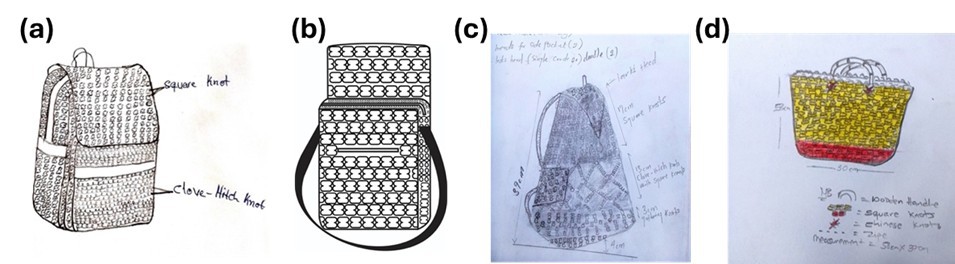
Figure 1.(a) Sketch of backpack with knot symbols, (b) Knot symbols used to illustrate the sketch, (c) dimensions and symbols used in sketch, (d) Colour to use for final product and dimensions illustrated in the sketch
Students accurately calculate the total length of cord required for a given Macramé project. The knowledge acquired from the formula was used to produce a 3-dimensional Macramé handbag and backpack. Macramé traditionally relies on trial and error to determine cord lengths, but by applying mathematical calculations, students can predict the exact amount of cord needed for a project. This method eliminates wastage and enhances efficiency in designing structured macramé projects such as 3D handbags and backpacks.
The adaptation of variables such as LH (length of lark head), LC (length of cord for the knot), LA (length of the article), LK (length of cord for the knot), X (variable for the square knot), Y (variable for the clove-hitch knot), and A (allowance) play pivotal roles in this approach which was based on their functional relevance to cord estimation in knotting Macramé. Integrating these variables aims to replace the experiential guesswork with a precise and calculated method for measuring the suitable length of cord required for a given article to be knotted. Formula for calculating the length of cord needed for an article (using Clove-Hitch and Square Knot). The formula was derived from calculated cord lengths were compared to estimates used by expert Macramé artisans to assess deviations and improvements.
The formula is structured in reference to the BODMAS formula. The BODMAS rule (Brackets, Orders, Division/Multiplication, Addition, Subtraction) is a fundamental principle in arithmetic that dictates the order of operations in mathematical expressions. In the context of the Macramé cord length formula, ensuring calculations follow BODMAS guarantees precision and consistency in determining the required cord length.

To be able to calculate the required length of cord required, using the 5mm PP cord, LH: length of lark head when mounted takes = 3.5cm; LC(x): length of cord needed for the square knot = 2cm; LC(y): length of cord needed for the clove-hitch knot = 2cm; LA: length of article = for example, if we need to knot = 64cm; LK: length of a square knot when knotted takes = 0.75cm; A: allowance (7cm).

2.3 | Phase 3 (4-week period)
During this stage, students were guided through the process of designing and producing the projects (handbag or backpack) as shown in Figure 2. In this phase, the sketches, dimensions, and knot symbols provided a clear plan that outlined which knots would be used, the project's overall form, step-by-step instructions, and the total length of cord required.
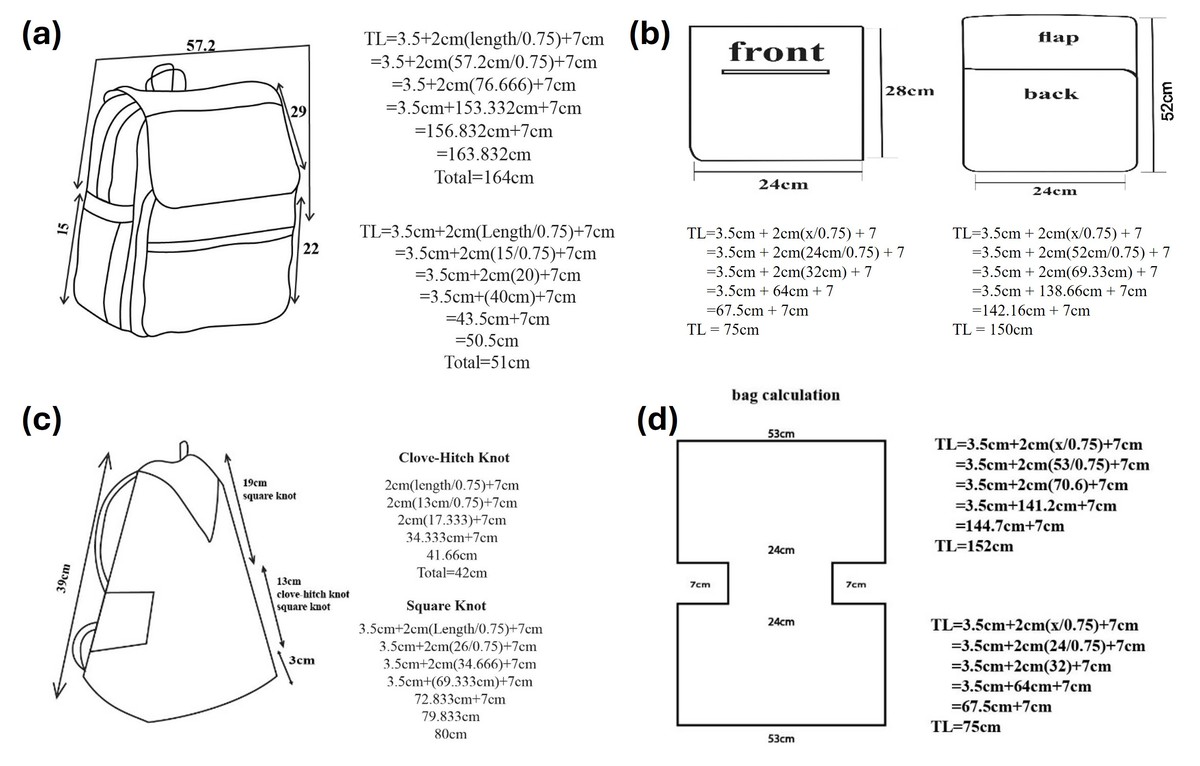
Figure 2.(a) Calculations of sketch done for Backpack A, (b) Calculations of sketch done for Bag B, (c) Calculations of sketch done for Crossbag C and (d) Calculations of sketch done for Backpack D
2.4 | Final Stage (2 weeks)
The final stage focused on completing the projects. Students learned finishing techniques, including attaching fabrics and sewing them onto the handbags or backpacks. Samples of the final Macramé projects from the experimental group, including both handbags and backpacks, as shown in Figure 3.
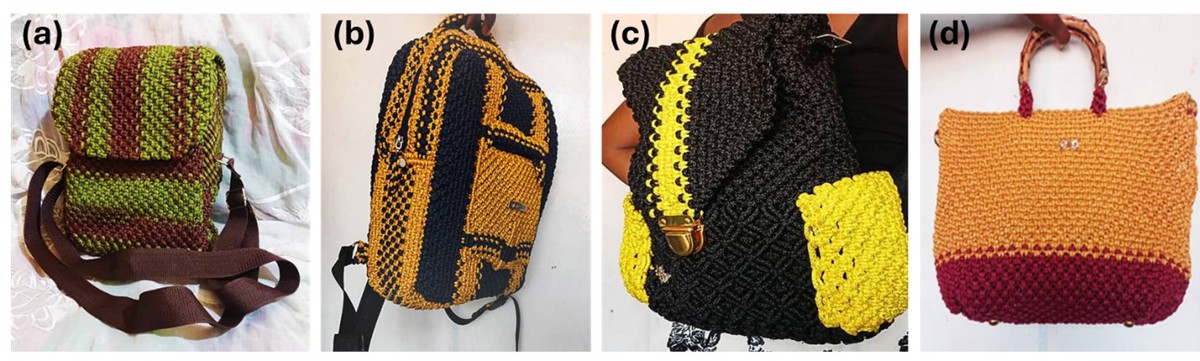
Figure 3.(a) Bag A Finished work from the formula, (b) Bag B Finished work using the formula, (c) Backpack C Finished work, (D) Bag D Finished work.
3 | RESULTS AND DISCUSSION
The analysis considered paired observations, ensuring that pre- and post-intervention measurements were taken from the same participants. Their pre- and post-test scores were dependent, which complies with the conditions of a paired t-test, even if each participant's replies were independent of the others. Furthermore, an interval scale was used to measure the motivation and engagement scales, guaranteeing the suitability of the statistical test.
Table 1: Paired T-test results for Year Two on Zaara Hybrid Model
| Paired Samples Test | |||||||||
| Pair | Variables | Paired Differences |
|
||||||
|
Mean
|
Std. Deviation
|
Std. Error Mean
|
95% Confidence Interval of the Difference |
|
|||||
| Lower | Upper | t | Df | P-value | |||||
| Pair 1 | Engagement Scale | 1.69 | 0.535 | 0.126 | 1.43 | 1.96 | 13.431 | 17 | <0.001 |
| Pair 2 | Motivation Scale | 1.742 | 0.701 | 0.165 | 1.39 | 2.09 | 10.542 | 17 | <0.001 |
| Pair 3 | Teaching and Learning Outcome | 1.805 | 0.538 | 0.127 | 1.54 | 2.07 | 14.225 | 17 | <0.001 |
To evaluate the effect of the intervention on student motivation, engagement, and overall teaching and learning outcomes, a paired t-test was used. The test makes the following assumptions: The pre- and post-intervention score differences need to roughly follow a normal distribution. The normality assumption was evaluated and found to be reasonable for performing the paired t-test, despite the sample size being very small. Pre- and post-test results for every student were paired, thus, measurements within each pair were reliant on one another. Nonetheless, the assumption of independence was satisfied because each participant's reaction was distinct from the other.
Table 1 shows inferential findings of student engagement and student motivation on teaching and learning outcomes. The analysis found that the statistical difference between the two means for the engagement scale t (17) = 13.43, p < .001, while for motivation is t (17) = 10.54, p < .001, which shows there is a statistical difference between the ‘before’ and ‘after’ the intervention. The overall (teaching and learning) results t (17) = 14.22, p < .001 further indicate significant improvements in engagement and motivation following the intervention, all at p-values less than 0.001, confirming the effectiveness of the intervention. Given the significance level of 0.05, all p-values are less than 0.05, indicating that: There is a significant difference in engagement and motivation after the hence teaching and learning were effective after the intervention, confirming the effectiveness in teaching Macramé.
4 | IMPLICATIONS OF FINDINGS
Students heavily rely on lecturers to determine the length and measurement of their practical work. However, the lack of accuracy in measurements for Macramé projects affects effective instruction. The introduction of mathematical formulas has paved the way for students to accurately determine the required measurements for any given project. Beyond improving accuracy, the introduction of a mathematical formula for teaching Macramé has far-reaching effects on sustainability in textile education. Material wastage and inefficiency, especially in knotting techniques, often compromise sustainable practices. By minimising cord waste and promoting precise measurement techniques, this approach supports sustainable design principles in Macramé education. Student engagement and motivation were assessed before and after the intervention. The intervention bridged the gap between artistic creativity and mathematical reasoning, demonstrating the interdisciplinary value of Macramé. By applying mathematical principles such as BODMAS to practical craftwork, students saw the relevance of mathematical concepts in real-world applications. This integration of structured problem-solving with artistic design may have appealed to both analytically minded and creatively inclined students, fostering broader engagement across different learning styles. Findings indicate that students were actively involved in the learning process, and the accuracy in cord length calculation led to a sense of achievement and confidence, making the teaching of Macramé more effective. Participants' engagement levels significantly increased after the intervention, with this improvement also being statistically significant. In terms of motivation, post-intervention scores showed a significant increase. Similarly, student performance improved substantially following the intervention. The overall teaching and learning results (p < .001) confirm significant improvements in engagement and motivation, reinforcing the effectiveness of the intervention.
5 | LIMITATIONS OF THE STUDY
The study was limited to Macramé and its integration with Instructional Design Models for teaching to Fibre and Fabric students in Year Two in the Department of Indigenous Art and Technology, KNUST. The study involved a relatively small number of participants, which may limit the generalizability of the findings to a broader population. The projects were limited to square and clove-hitch knots, which restricted the variety of knotting techniques explored.
6 | CONCLUSION AND FUTURE STUDIES
Teaching Macramé places a strong emphasis on practical application; however, students struggle to learn the skills they need because of a lack of materials and inefficient teaching strategies. The goal of the course is to give students skills that are relevant to the industry, but as technology advances, curricula must be updated to meet 21st-century learning skills. The study's conclusions, which are corroborated by paired t-test results (t (17) = X, p <.001), show that the intervention greatly improved learning outcomes, motivation, and student involvement. In order to reduce guesswork, maximise material utilisation, and promote efficiency in the delivery of education, a mathematical approach to cord length estimation has been introduced. This method is structured and reproducible. Additionally, by bridging the gap between STEM and artistic disciplines, incorporating mathematical formulas into Macramé education enhances interdisciplinary learning. This method strengthens students' capacity to apply mathematical concepts in a creative and useful way by giving them the tools they need to solve problems. The formula-based approach also supports sustainability objectives in textile education. Sustainability in craft education is not just about minimising waste; it is also about producing high-quality, durable products. The use of accurate cord length measurements ensures that Macramé projects are structurally sound and well-proportioned by decreasing material waste and increasing accuracy, guaranteeing that craft-based learning stays creative and economical.
ACKNOWLEDGMENTS
We would like to acknowledge the efforts of the students at the Department of Indigenous Art and Technology and the students at Tamale Technical University who helped in making the experiment a success.
ETHICS APPROVAL STATEMENT
The Ethics committee at Kwame Nkrumah University of Science and Technology approved the set of questions before data collection started. Respondent was told about the purpose of the study; hence, his consent was taken before he proceeded to answer the interview questions. Also, the confidentiality and anonymity of respondents was assured.
DATA AVAILABILITY STATEMENT
Data sharing will be made available on request.
CONFLICT OF INTEREST STATEMENT
The authors declare no conflict of interest.
DECLARATION OF GENERATIVE AI AND AI-ASSISTED TECHNOLOGIES IN THE WRITING PROCESS
During the preparation of this work, the author(s) used quilbot to paraphrase some quotes and chat GPT to help analyse some statements. After using this tool/service, the author(s) reviewed and edited the content as needed and take(s) full responsibility for the content of the publication.
ORCID
Fatimatu Hajia Ibrahim
-
 https://orcid.org/0009-0009-1105-6900
Boakye Antwi
-
https://orcid.org/0009-0009-6931-9195
Karim Azumah
-
https://orcid.org/0000-0003-3266-5536
Issah Mohammed Seini
-
https://orcid.org/0009-0006-3439-9904
REFERENCES
- Adams, C. C. (2004). The knot book: an elementary introduction to the mathematical theory of knots. American Mathematical Soc. Available at: https://www.math.cuhk.edu.hk/course_builder/1920/math4900e/Adams--The%20Knot%20Book.pdf (accessed on November 20, 2024)
- Aheto-Tsegah, C. (2011). Education in Ghana–status and challenges. Commonwealth education partnerships, pp.27-29. https://www.cedol.org/wp-content/uploads/2012/02/Charles-Aheto-Tsegah-article.pdf
- Asmah, A. E., & Daitey, M. M. M. S. T. (2015). The developments of macramé as a viable economic venture in Ghana. European Journal of Research and Reflection in Arts and Humanities, 3(4), 11-21.
- Atika, J. & Purwanti, L. (2022). The use of makrame handicrafts for room decoration with the concept of Art Deco. Journal of Research of the Arts, Design and Media, 1(1), 45-56.
- Barbosa, G. S., Drach, P. R., & Corbella, O. D. (2014). A conceptual review of the terms sustainable development and sustainability. Journal of Social Sciences, 3(2), 1.
- Bartlett, S. (2020). Knot Magic: A Handbook of Powerful Spells Using Witches' Ladders and Other Magical Knots. Wellfleet Press. New York, USA.
- Billett, S. (2011). Vocational education: Purposes, traditions and prospects. Springer Science & Business Media. https://doi.org/10.1007/978-94-007-1954-5
- Carter R. (1996). The History of Macrame. In Turner, J. C. (Eds.), History of Science and Knots, World Scientific Publishing, Singapore. https://www.worldscientific.com/doi/epdf/10.1142/2940
- Cobb, K., Orzada, B. and López-Gydosh, D. (2020). History is Always in Fashion: The Practice of Artifact-based Dress History in the Academic Collection. Journal of Textile Design Research and Practice, 8 (1), 4–23. Available from https://doi.org/10.1080/20511787.2019.1580435
- Darling-Hammond, L. (2006). Powerful teacher education: Lessons from exemplary programmes. John Wiley & Sons, San Francisco, CA.
- Deale, C., Nichols, J., Jacques, M. S., & Jacques, P. (2009). A descriptive study of sustainability education in the hospitality curriculum. Journal of Hospitality and Tourism Education, 21(4), 34-42. https://doi.org/10.1080/10963758.2009.10696958
- Doble, L., Bohm, G. & Şuteu, M.D., 2023. Creative Solutions for The Use of Textile Waste. Annals of the University of Oradea. Fascicle of Textiles, Leatherwork, 24(2), p 31.
- Eurydice. (2009). Arts and cultural education at school in Europe. Available at: https://op.europa.eu/en/publication-detail/-/publication/0e41e888-7d1b-4073-adea-502974017735 (accessed on February 5, 2014)
- Finnish National Board of Education (FNBE) (2004). National Core Curriculum for Basic Education 2004. Finnish National Board of Education, Helsinki, Finland. Available at: https://www.ibe.unesco.org/curricula/finland/fi_befw_2004_eng.pdf (accessed on November 20, 2024)
- Golden, A. J. (2003). Unique Handmade Books. Sterling Publishing Company, Inc., New York.
- Hala, S. (2024). Creating Contemporary Fashions Using the Art of Macrame in light of Sustainable Fashion, International Design Journal, Vol. 14 No. 4, pp 505-520.
- Heywood, D., Parker, J. & Jolley, N. (2012). Pre-service teachers’ shifting perceptions of cross-curricular practice: The impact of school experience in mediating professional insight. International Journal of Educational Research, 55, 89-99. https://doi.org/10.1016/j.ijer.2012.07.003
- Hickman, R., & Huckstep, P. (2003). Art and mathematics in education. Journal of Aesthetic Education, 37(1), 1-12. https://doi.org/10.2307/3527417
- Horst, D. (1973). An experimental study: comparing a pattern approach to a creative approach in teaching macramé. Department of Art. Kansas State Teachers College of Emporia. Master of Arts. https://dspacep01.emporia.edu/bitstream/handle/123456789/2590/Horst%201973.pdf?sequence=1
- Ibrahim, H. F. (2018). Adapting Successive Approximation Model to create Macramé patterns for teaching accessory making in Fashion design and Textiles. Department of Educational innovations in science and technology. Faculty of Art. KNUST. Unpublished theses
- Issah, M. S., Ameyaw, E. A. & Ibrahim, F. H. (2023), Diversity of Vegetable-tanned Leather for Sustainable Development. Annals of the University of Oradea. Fascicle of textiles, leatherwork. Vol 24, Issue 1, p67
- Jubaer, S. M. O. F. & Hoque, L. (2021). The Concept of Education: A Western Rationalist Approach. International Journal on Integrated Education, 4(6), pp.138-150.
- Kokko, S., Eronen, L. & Sormunen, K. (2015). Crafting maths: Exploring mathematics learning through crafts. Design and Technology Education: An International Journal, 20(2), pp.22-31.
- Landgren, T. M., & Pasricha, A. (2011). Transforming the fashion and apparel curriculum to incorporate sustainability. International Journal of Fashion Design, Technology and Education, 4(3), 187-196. https://doi.org/10.1080/17543266.2011.613856
- LaVelle, J. M., Lovato, C. & Stephenson, C. L. (2020). Pedagogical considerations for the teaching of evaluation. Evaluation and program planning, 79, p.101786. https://doi.org/10.1016/j.evalprogplan.2020.101786
- Marchen Art Studio (2013). Macramé Pattern Book. St. Martin’s Press, 175 Fifth Avenue, New York, N. Y. 10010.
- Marlina, M. (2020). The assessment instrument product of macramé technique in textile craft course. In IOP Conference Series: Materials Science and Engineering (Vol. 830, No. 4, p. 042062). IOP Publishing.
- Mate, M. M. (2019). Processing and Utilization of Selected Local Plant Fibres for Macramé. Department of Educational Innovations in Science and Technology. Faculty of Art, KNUST. https://ir.knust.edu.gh/server/api/core/bitstreams/4745b92b-6f99-42bd-8448-f0af349e329a/content
- Milligan, C. (2009). Mod Knots: Creating Jewelry and Accessories with Macramé́. North Light Books, an imprint of F+W Publications, Inc. 4700 East Galbraith Road, Cincinnati, Ohio.
- Mireku, D. O. (2016). Combination of crochet and macramé́ techniques for the production of interior textile artefacts. Master's Thesis, KNUST. https://ir.knust.edu.gh/handle/123456789/9423
- Pasricha, A. (2012). Student expectations on content and pedagogy for sustainability within textiles and apparel curricula. In W. L. Filho (Ed.), Sustainable development at universities: New horizons (pp. 135–148). New York, NY: Peter Lang Scientific Publishers.
- Patton, M.Q. (2017). Pedagogy of evaluation: New directions for evaluation, Number 155. John Wiley & Sons.
- Phillips, M. W. (2013) "Creative Knitting: A New Art Form". Courier Corporation Ltd. Mineola: New York Available at: https://books.google.com.gh/books?hl=en&lr=&id=P8k5_x04WWYC&oi=fnd&pg=PP1&dq=Phillips,+M.+W.+(2010)+%22Macram
- Sintim, M. D. (2008). Comparative study of teaching and learning of textiles in selected Senior High Schools and Vocational Institutions in the Eastern Region of Ghana, Master's Thesis, Kwame Nkrumah University of Science and Technology, Kumasi. https://ir.knust.edu.gh/handle/123456789/165
- Spendlove, D. & Barlex, D. (2011). Researching STEM? Design and Technology Education: An International Journal, 16 (1), 3–5.
- Välijärvi, J., Kupari, P., Linnankylä, P., Reinikainen, P., Sulkunen, S., Törnroos, J. & Arffman, I. (2007). The Finnish success in PISA – and some reasons behind it 2, PISA 2003. Available at: https://jyx.jyu.fi/bitstreams/05eb11e9-40ca-4708-87c0-52a47bdd5855/download (accessed on February 5, 2018).
- Webber, G. and Miller, D. (2016). Progressive Pedagogies and Teacher Education: A Review of the Literature. McGill Journal of Education, 51(3), 1061-1079. https://doi.org/10.7202/1039628ar
- Wilson, K. (2021). A history of textiles. Routledge. https://doi.org/10.4324/9780429049101
- Younse, D. S. (2012). Alternative Pedagogy: The One Room Schoolhouse and the Trojan Experiment. M