



1 | INTRODUCTION
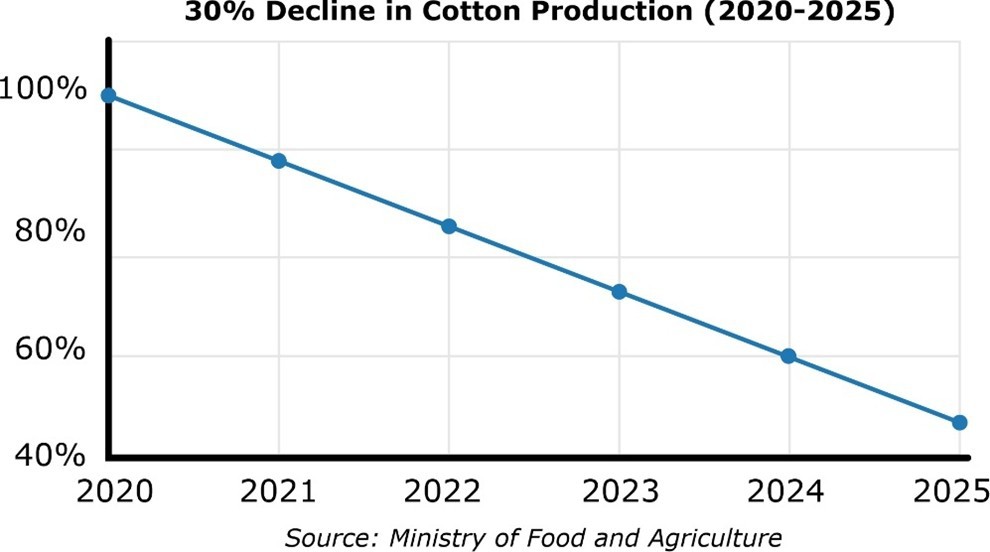
Ghana's cotton industry, once a promising sector, is facing a catastrophic downturn with devastating effects for farmers, communities, and the national economy. This isn't only a claim; it's a fact proven by a 30% loss in cotton output between 2018 and 2022, resulting in a $15 million decrease in export earnings. This reduction (Figure 1) directly affects the lives of approximately 200,000 cotton farmers in the Northern and Upper West Regions, where cotton farming is a key source of revenue. Furthermore, the closure of three large textile mills in the previous five years, directly connected to the declining supply of raw cotton
(Amankwah-Amoah, 2015), shows the cascading impact of this reduction on downstream sectors and jobs.
Figure
1
: Decline in cotton production (2020 – 2025). (Field Data, 2025)
This research focuses explicitly on the role of soil health management in this decrease, evaluating how unsustainable soil management methods lead to decreasing yields and assessing the possibilities of sustainable alternatives. While variables like climate change and availability to inputs contribute to the issue, research has demonstrated a substantial association between unsustainable agricultural methods, notably concerns about soil health, and lower cotton yields (Nizzoli, 2023). For example, research by Adam and Abdulai (2023) indicated that cotton farms in Ghana adopting conventional tillage procedures saw a 20% lower production compared to those implementing conservation tillage methods. These unsustainable methods not only affect the environment but also pose major health hazards to cotton farmers and their communities (Nizzoli, 2023).
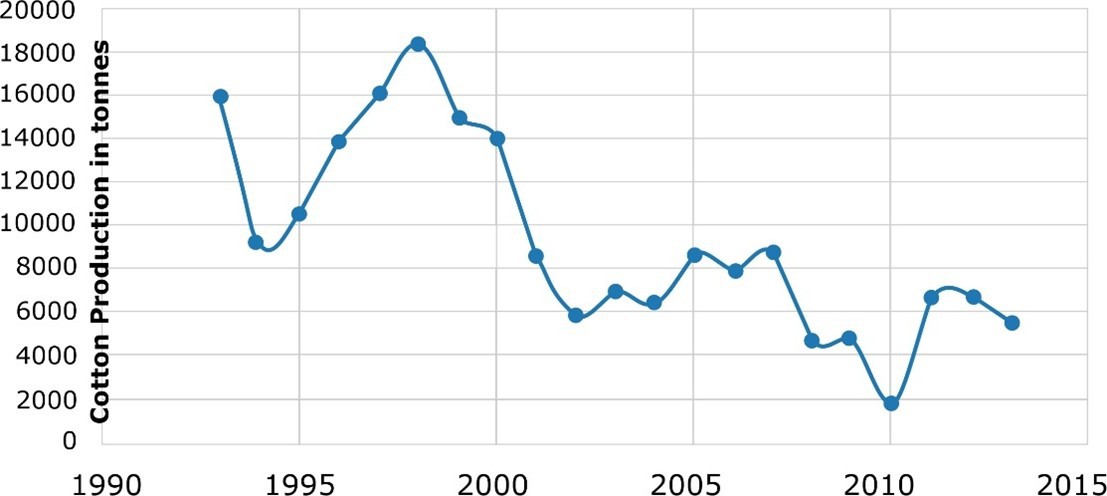
The shift to sustainable cotton farming, especially addressing soil health, is not merely an ecologically good decision; it's a strategic need for rejuvenating Ghana's cotton business. Sustainable soil management strategies, such as crop rotation, cover cropping, and decreased tillage, provide a road to boosting soil fertility, promoting water retention, and increasing resistance to drought (Hussain et al., 2021). These changes may translate directly into greater cotton yields, better fibre quality, and decreased input costs, ultimately enhancing farmer profitability and strengthening Ghana's competitive advantage in the global cotton market. Figure 2 shows the cotton production in Ghana. Importantly, sustainable cotton production fits with the expanding worldwide consumer demand for ethically produced commodities, offering new market possibilities and the possibility for premium pricing. This change in consumer desire creates a tremendous economic incentive for farmers to embrace sustainable techniques. International programs like the Better Cotton Initiative (BCI) (BCI, 2024) and Cotton Made in Africa (CmiA) (CmiA, 2023) encourage sustainable cotton production via farmer education, certification systems, and market access. While BCI works in Ghana, its adoption rate remains low, demonstrating the existence of context-specific constraints. For instance, a 2022 report by the BCI Ghana Chapter stated that just 15% of cotton farmers in the target areas had implemented BCI-compliant methods, citing lack of access to technical help and the perceived high cost of implementation as main barriers. This research will look at the causes for this low adoption, including how variables such as farmer knowledge, resource availability, and institutional support impact the adoption of sustainable soil health practices.
Figure
2
. Cotton Production in Tonnes
(Zakaria, 2016).
Despite the widely recognised relevance of sustainable cotton farming, putting this notion into practice needs a focused and in-depth study of the Ghanaian cotton farming setting. While there is a large body of research on sustainable agriculture in general, as well as cotton production in other regions, there is a critical gap in understanding how sustainable soil health practices can be effectively implemented in Ghana. Existing research generally focuses on national-level agriculture policies and frameworks
(Dalla et al., 2021), which are too broad to address the specific difficulties that cotton producers experience at the district level. These obstacles include limited access to specialised extension services for soil health management, the impact of local political dynamics on resource allocation for agricultural development, and the complexities of engaging with diverse farming communities to promote the adoption of new practices. For example, although national agricultural extension policies may promote integrated soil fertility management, they often fail to give practical advice on how farmers may apply these ideas to their individual soil types, cropping systems, and resource restrictions at the district level. This research fills a vacuum by focusing on the process of establishing sustainable soil health practices in cotton-growing communities in the target regions.
The research aims to evaluate how cotton farmers in Ghana currently manage their soil and how these methods align with the Better Cotton Initiative (BCI) criteria for sustainable soil health. This assessment will provide a baseline understanding of existing practices and their compatibility with international standards. In order to achieve this, the following research questions need to be addressed: 1) How do the present soil management methods of cotton producers in the target areas relate to the BCI's sustainable soil health criteria? 2) What technical, economic, social, and institutional variables permit or limit these farmers' adoption of sustainable soil health practices? 3) How do these elements combine to impact farmers' decisions on soil health management? 4) What specific, actionable interventions may be developed to overcome the identified obstacles and increase the adoption of sustainable soil health practices among Ghanaian cotton farmers? By answering these questions, this research will give a thorough knowledge of the processes and dynamics involved in adopting sustainable soil health measures in Ghanaian cotton cultivation. The findings will provide valuable, context-specific insights for policymakers, extension services, NGOs, and cotton farmers, guiding the development of targeted interventions to improve soil health, increase cotton yields, and contribute to the long-term sustainability and revitalisation of Ghana's cotton industry.
2 | LITERATURE REVIEW
2.1 | The Triple Bottom Line (TBL)
Elkington and Rowlands (1999) Triple Bottom Line (TBL) paradigm, a fundamental concept in sustainability, advocates for the integration of environmental stewardship, economic viability, and social equity within agricultural practices, specifically cotton farming. This framework moves beyond mere profit maximisation, emphasising that long-term success necessitates a balanced approach to protecting natural resources through reduced chemical inputs and water conservation, ensuring financial viability via efficient farming and fair market access, and enhancing social well-being through fair labour practices, gender inclusion, and community development. By harmonising these three pillars, the TBL provides a holistic strategy for sustainable cotton cultivation, encouraging stakeholders to adopt practices that foster environmental resilience, economic growth, and social fairness (Gimenez et al., 2012; Nizzoli, 2023; FAO, 2017; Jehangir et al., 2024; Ullah et al., 2016; Srivastava et al., 2022).
In this study, the TBL framework served as a guiding principle to analyse the multifaceted factors influencing the adoption of sustainable soil health practices among cotton farmers in Ghana. Specifically, it provided a lens through which to examine how environmental concerns (e.g., soil and water pollution), economic factors (e.g., input costs, market prices), and social considerations (e.g., community norms, and labour practices) interact to shape farmers' decisions. By considering these three dimensions, the research aimed to identify holistic interventions that not only improve soil health but also enhance the economic and social well-being of cotton farming communities. The TBL theory informed the development of interview questions and the interpretation of findings, ensuring that the study addressed the interconnectedness of sustainability in the context of Ghanaian cotton farming.
2.2 | The Diffusion of Innovations Theory
Rogers' (2003) Diffusion of Innovations Theory explains how new ideas and technologies spread through a population over time. It posits that adoption is a process influenced by the characteristics of innovation, the communication channels used, the social system, and time. Key elements include innovation’s relative advantage, compatibility, complexity, trialability, and observability. Individuals are categorised into adopter groups: innovators, early adopters, early majority, late majority, and laggards. The theory emphasises that adoption is not instantaneous but a gradual process involving awareness, persuasion, decision, implementation, and confirmation. Effective diffusion strategies consider these stages and tailor communication and support accordingly.
In this study, the Diffusion of Innovations Theory provided a framework to understand how sustainable soil health practices are adopted among cotton farmers in Ghana. Specifically, it helped to analyse the factors influencing the rate and extent of adoption. The theory guided an investigation into how farmers perceive the relative advantage, compatibility, and complexity of sustainable practices like cover cropping, reduced tillage, and organic fertilisation. It also informed the exploration of communication channels, such as farmer field schools and extension services, and the role of social networks in spreading information. By identifying the characteristics of sustainable practices that facilitate or hinder adoption, and by understanding the different adopter categories within the farming community, the research aimed to provide insights for developing targeted interventions and communication strategies to accelerate the diffusion of sustainable soil health management. This theory helped to explain the current levels of adoption and why some farmers were more likely to use certain practices than others.
2.3 | Better Cotton Initiative
The concept of sustainable industrialisation is central to the UN's Sustainable Development Goals (Faulkner et al., 2012). Participants in the Better Cotton Initiative (BCI) should produce cotton in an ecologically friendly and socially sustainable manner (Addis et al., 2021). The World Wide Fund for Nature (WWF) initiated the BCI standard-setting process in 2003-2004. The WWF chose palm oil, soy, sugar cane, and cotton as commodities for development due to the sustainability impact, financial sector traction, and added value that the IFC/WWF sector-wide initiatives could provide for each commodity (IIED/ProForest, 2004; Addis et al., 2021). This included the introduction of the BCI standard-setting procedure (Figure 3).
|
BCI farmers:
|
Figure 3: The BCI’s production principles and criteria (BCI, 2013)
2.4 | Sustainable Cotton Farming
The concept of sustainable cotton farming is multifaceted, lacking a universally accepted definition. While it generally encompasses ecological soundness, social equity, and economic viability, its practical application varies across studies (Elkington & Rowlands, 1999). Some research adopts a farm-centric approach, focusing on "Better Management Practices" (BMPs) such as integrated pest management, soil health enhancement, and water conservation (Ullah et al., 2016; Vitale et al., 2024). These studies prioritise field-level agronomic techniques and assess sustainability through yield improvements, cost reductions, and environmental indicators (Jehangir et al., 2024). However, this approach may overlook broader socioeconomic factors.
Conversely, organisations like the Ethical Trading Initiative and Fairtrade International expand the definition to include supply chain and market considerations. They emphasise fair prices, decent working conditions, and market access for sustainably produced cotton, recognising the link between farm-level sustainability and larger economic and social systems
(Gimenez et al., 2012). This study adopts a comprehensive definition that integrates both on-farm techniques and the broader socioeconomic framework to provide a holistic understanding of sustainability in Ghana's cotton sector. This approach acknowledges that technical improvements must be coupled with systemic reforms in market access, pricing, and social equity to achieve lasting impact
(Nizzoli, 2023).
2.5 | Cotton Farming in Ghana
Ghana's cotton farming has experienced fluctuating fortunes since its colonial origins, marked by initial stagnation due to infrastructure limitations and competition with crops like cocoa. Post-independence efforts to revitalise the sector through state-run entities faced challenges from internal inefficiencies and global market volatility, resulting in marginal global market participation, as shown in Table 1. Agricultural sector liberalisation in the 1980s and 1990s further complicated matters, but a resurgence in the early 2000s, driven by demand for sustainable cotton and NGO initiatives, offered new opportunities. Despite these efforts, the sector remains underdeveloped, facing issues like poor agronomic practices, limited technology access, inadequate irrigation, and climate change impacts. Establishing Ghana as a competitive player requires collaborative efforts from the government, private sector, and civil society, learning from past experiences to create a conducive environment for sustainable cotton farming.
Table
1
. Cotton Production and Exports in Ghana (1980-2007)
| Year | World Production ('000 tonnes) | Ghana Production ('000 tonnes) | Ghana % of World | World Export ('000 tonnes) | Ghana Export ('000 tonnes) | Ghana % of World |
|
1980 |
13,799 |
12 |
0.09 |
5,719 |
6 |
0.10 |
|
1985 |
17,450 |
18 |
0.10 |
6,114 |
10 |
0.16 |
|
1990 |
18,975 |
24 |
0.13 |
6,437 |
15 |
0.23 |
|
1995 |
20,439 |
35 |
0.17 |
5,958 |
20 |
0.34 |
|
2000 |
19,400 |
42 |
0.22 |
5,705 |
25 |
0.44 |
|
2001 |
21,491 |
38 |
0.18 |
6,347 |
22 |
0.35 |
|
2002 |
19,809 |
30 |
0.15 |
6,632 |
18 |
0.27 |
|
2003 |
21,067 |
28 |
0.13 |
7,229 |
16 |
0.22 |
|
2004 |
26,441 |
35 |
0.13 |
7,624 |
20 |
0.26 |
|
2005 |
25,383 |
30 |
0.12 |
9,708 |
17 |
0.18 |
|
2006 |
26,561 |
24 |
0.09 |
8,077 |
14 |
0.17 |
|
2007 |
26,245 |
18 |
0.07 |
8,370 |
10 |
0.12 |
Source: The Agricultural Management Practices Survey Data (2025)
2.6 | Current Soil Management Practices
Studies highlight the dominance of traditional agricultural practices in Ghana's cotton sector, posing threats to long-term sustainability
(Vitale et al., 2024;
Nizzoli, 2023). Concerns have been raised about the excessive use of synthetic pesticides and the deterioration of soil health due to monocropping and poor land management
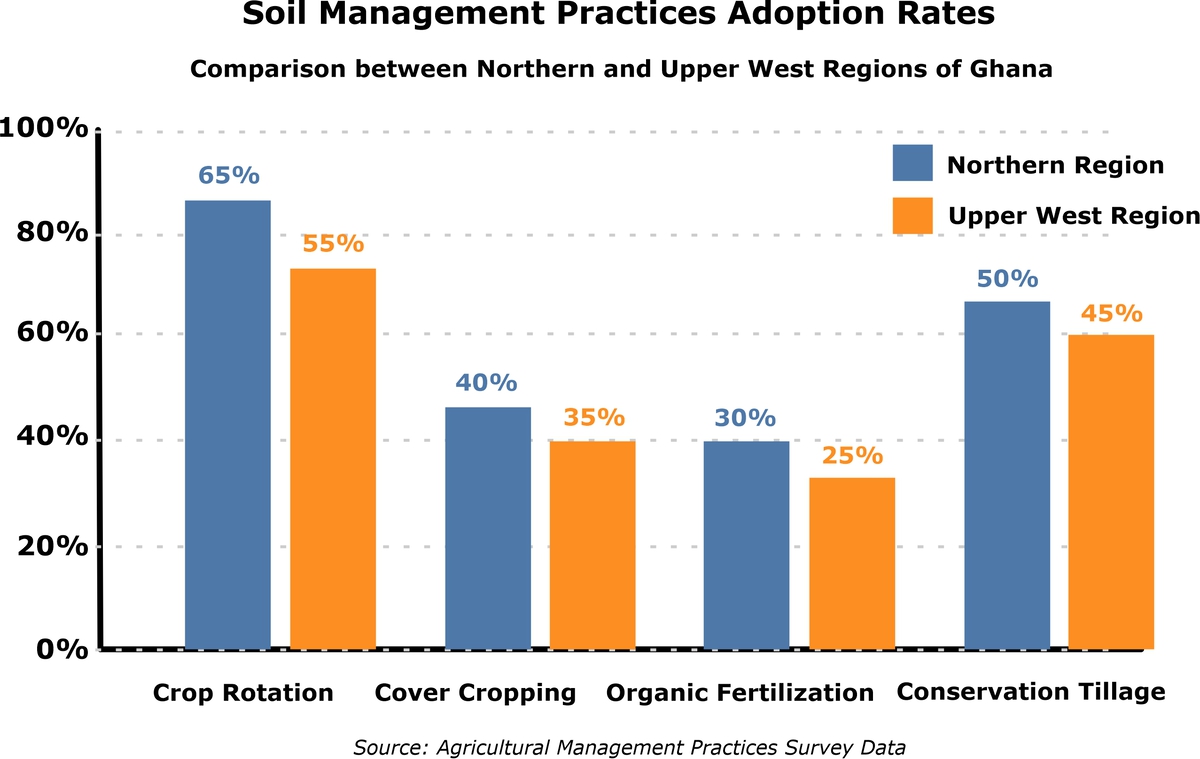
(Akmal, 2023). While studies advocate for IPM and soil-enhancing practices, they often lack detailed information on specific practices. This study aims to fill this gap by documenting pest management practices, tillage, fertiliser use, and crop rotation schemes in the Northern and Upper West Regions. Table 2 presents the adoption rates of these practices, showing variations between regions, with crop rotation being the most adopted practice and organic fertilisation the least.
Table 2. Adoption Rates of Soil Management Practices in Northern and Upper West Regions
| Soil Management Practice | Northern Region (%) | Upper West Region (%) |
|
Crop Rotation |
65 |
55 |
|
Cover Cropping |
40 |
35 |
|
Organic Fertilization |
30 |
25 |
|
Conservation Tillage |
50 |
45 |
Source: The Agricultural Management Practices Survey Data (2025)
Ghana's rain-fed cotton farming is vulnerable to climate change-induced variable rainfall
(Yaouba et al., 2024). Precision irrigation success in other developing countries contrasts with technical and financial barriers in Ghana
(Brahmanand & Singh., 2022;
Yaouba et al., 2024). This study examines adaptation measures like water conservation and drought-resistant varieties. By documenting these strategies, this research aims to identify climate-resilient agricultural practices. Existing studies lack detailed data on specific soil management practices in the Northern and Upper West Regions, which this study addresses. Figure 4, based on the 2025 Agricultural Management Practices Survey data, will visually represent the adoption rates of soil management practices, providing a clearer picture of the current situation and its sustainability implications.
Figure
4
. Soil Management Practices Adoption Rates (Agricultural Management Practices Survey Data, 2025)
2.7 | Farmers' Understanding of Sustainable Soil Health Practices
Research highlights a general sustainability awareness in agriculture, but lacks specific insights into Ghanaian cotton farmers' understanding of sustainable soil health practices. Current studies often focus on broad sustainability principles, neglecting farmers' nuanced comprehension of soil-specific methodologies (Ullah et al., 2016). This study bridges this gap by assessing cotton farmers' comprehension of key sustainable soil health principles, such as cover cropping, reduced tillage, and organic fertilisation. It goes beyond mere awareness measurement, investigating the depth of farmers' knowledge and identifying any misconceptions.
Furthermore, while experiences from other developing nations offer valuable comparative insights, they often lack a nuanced understanding of how Ghanaian cotton farmers perceive these practices within their socio-cultural and agro-ecological contexts. This study addresses this gap by examining farmers' perceived advantages and obstacles related to implementing sustainable soil health measures. It seeks to understand the reasons behind farmers' reluctance to adopt certain practices, despite awareness, and aims to understand the rationale behind farmers' actions by examining how their perceptions of sustainable soil health practices influence their adoption choices. By directly evaluating farmers' comprehension, investigating perceived advantages and obstacles, and analysing how these perceptions influence decisions, this research offers a context-specific understanding of factors affecting adoption among Ghanaian cotton farmers. This comprehension is essential for formulating effective interventions that address farmers' specific needs and concerns, fostering broader adoption of sustainable soil management practices.
2.8 | The Adoption of Sustainable Soil Health Practices
Current research identifies numerous obstacles to sustainable cotton production in Ghana, spanning agronomic, economic, social, and institutional domains (Vitale et al., 2024; Yaouba et al., 2024; Seini & Nyanteng, 2005), but often lacks a focused analysis of how these factors specifically impact the adoption of sustainable soil health measures. This study aims to explore the complex interactions of these elements, going beyond mere identification to understand their influence on farmers' soil management decisions, specifically investigating the relationships between economic variables like price volatility, input costs, and loan access, and their impact on soil health management choices, as well as the interplay of social variables, including community norms, peer influence, and access to extension services through cooperatives, with other determinants of farmers' soil management choices.
This study moves beyond identifying technical, economic, social, and institutional factors to understand their interactions and impact on farmers' decisions about sustainable soil health. By analysing how limited equipment access (technical) combines with perceived high costs (economic), and how community norms (social) and government policies (institutional) influence farmers' decisions, this study will provide a comprehensive understanding of factors influencing the adoption of sustainable soil health practices among Ghanaian cotton farmers. This understanding is essential for formulating effective interventions that address the complex, interrelated challenges faced by farmers and promote widespread adoption of sustainable soil management.
3 | METHODOLOGY
This study employed a qualitative research methodology to explore the perspectives and experiences of cotton farmers in Ghana's Northern and Upper West Regions regarding the adoption of sustainable soil health practices. A qualitative approach was chosen for its ability to provide in-depth insights into the complex social dynamics surrounding agricultural practices, yielding rich, contextualised data on farmers' motivations, challenges, and perceived needs (Creswell & Poth, 2016). This research aimed to uncover the rationale behind farmers' soil management practices through a qualitative approach that emphasises thorough investigation and interpretation of meaning. As Guest et al. (2006) argue, qualitative research excels in examining complex social phenomena where contextual understanding is paramount.
Specifically, semi-structured interviews were conducted with forty cotton farmers from the Northern and Upper West Regions. The sample size was determined using the concept of data saturation, aiming to reach a point where subsequent interviews yielded minimal new insights (Guest et al., 2006). This approach ensures the data collected is sufficiently rich and comprehensive to address the research objectives, aligning with best practices in qualitative research. Rahimi (2024) emphasises data saturation as a fundamental requirement for sample size in qualitative research, ensuring credibility and reliability. Purposive sampling was employed to ensure representation of farmers with diverse experiences and perspectives on soil health management, including those who had adopted sustainable practices (e.g., crop rotation, cover cropping, reduced tillage) and those who primarily relied on traditional methods. This diversity enabled a holistic understanding of the factors influencing adoption. The sample comprised 25 men and 15 women, with an average age of 48 years and an average of 15 years of cotton farming experience. Recognising women's crucial role in agricultural decision-making in many African contexts, the gender balance was deemed essential to capture any gender-based variations in soil management practices or perspectives (Puskur et al., 2023). The average age and experience reflect the established nature of cotton farming in these regions, indicating participants possessed valuable insights into long-term trends and challenges concerning soil condition.
The interview guide was developed based on a comprehensive review of literature on sustainable soil health practices and agricultural extension in similar contexts (Röling, 2019; Hazell & Haddad, 2001; Dalla et al., 2021). The guide consisted of open-ended questions designed to elicit farmers' views on their current soil management practices, their understanding of sustainable soil health practices, the perceived advantages and challenges of adopting these practices, sources of information on soil health, and their perceived support needs for transitioning to sustainable methods. The open-ended nature of the questions allowed participants to elaborate on their experiences and provide rich, detailed responses, aligning with the principles of qualitative interviewing as suggested by Rubin and Rubin (2011). The interview guide was pilot tested with five farmers in the target areas to ensure clarity, relevance, and cultural appropriateness. Based on the pilot test, minor adjustments were made to the phrasing of some questions to improve flow and understanding.
Interviews, conducted for approximately 45 to 60 minutes, were conducted using the primary languages spoken in the target areas. Interviews were typically conducted on farmers' fields or in their homes, providing comfortable and familiar settings conducive to candid discussions. Audio recordings were made using encrypted digital recorders to ensure data security and anonymity. A professional transcription service provided verbatim transcripts, which were then reviewed for accuracy by the researcher. Several strategies were employed to ensure the credibility of the data. First, member checking allowed participants to review their interview transcripts and provide feedback on the accuracy of interpretations. As Lincoln and Guba (1988) argue, this process not only validated the data but also empowered participants by giving them a voice in the research process. Second, triangulation was used to compare interview data with data from secondary sources and reports from agricultural NGOs operating in the region. This triangulation enhanced the validity of the findings by contextualising the interview data and identifying any contradictory evidence (Patton, 2014). Third, a detailed audit trail was maintained throughout the study, documenting all decisions made regarding data collection, processing, and interpretation. This audit trail ensured the rigour and credibility of the research process through transparency, thereby enhancing the reliability of the findings (Shenton, 2004).
Data analysis was conducted using thematic analysis, following Braun and Clarke's (2006) six-phase framework. This involved several key stages. First, the researcher became familiar with the data through repeated listening to the recordings and reading the transcripts. This immersion facilitated a comprehensive understanding of the farmers' perspectives and experiences. Second, a coding system was developed based on the research questions and the interview guide. The initial coding was primarily descriptive, labelling segments of text related to key topics such as current soil practices, understanding of sustainable practices, perceived advantages and challenges, information sources, and support needs. Initial codes included "Tillage Methods," "Fertiliser Use," "Crop Rotation Knowledge", "Cost of Inputs," and "Access to Extension Services". Coding was done manually. To ensure inter-coder reliability, a second researcher independently coded 20% of the transcripts. Code discrepancies were resolved through discussion and consensus. Third, codes were organised based on recurring patterns and relationships. This involved identifying broader themes that captured the essence of the data for each research objective. For example, codes related to resource access, input costs, and credit availability were organised under the overarching theme of "Economic Factors Influencing Adoption". Fourth, each theme was clearly defined and named to convey its meaning. The themes were reviewed in relation to the research questions to ensure they provided relevant and insightful answers. Fifth, carefully selected quotations from participants were used to support and illustrate each theme, providing rich, contextualised evidence for the findings. Finally, the report was written, integrating the themes and supporting them with farmers' narratives, providing a comprehensive and nuanced picture of their perspectives and experiences. Thematic analysis was chosen for its flexibility and rigour in analysing qualitative data, enabling the identification of both explicit and implicit themes (Nowell et al., 2017).
This study received ethical approval from the KNUST Inst