



1 | INTRODUCTION
Cultural knowledge is significant for contemporary settings due to its impact on identity formation (Ott & Pozzi, 2011). It is crucial for nation-building and historical preservation. Archiving cultural heritage is important for economic, historical, and cultural processes (Hani et al., 2012). Archiving culture offers research scopes in products like films, video games, and digital media, as creating new cultural artefacts is a significant approach to demonstrate the importance of culture (Barwick, 2012). Video games not only represent culture from a particular time and location but also act a digital archive for a culture. Digital archive refers to the archiving of any information or cultural heritage through digital media like films, computer games, and audio. Representation on the other hand, refers to portrayal of any information within a media. The cultural representation in video games can be enhanced through cutting-edge computer graphics and artificial intelligence. The feasibility of digitally archiving a culture in a video game can be evaluated by the successful representation by the video game. Video Games can digitally archive the fashion of a specific culture through preserving, reproducing, and appreciating cultural content of a particular period or location (Laamarti et al., 2014; Mortara et al., 2014). Due to the functioning nature of video games, the audience can freely access the culture portrayed in video games than in traditional media (Malegiannaki & Daradoumis, 2017). Several studies have focused on the effectiveness of video games in archiving culture (Rapp et al., 2019). Scholars are interested in the incorporation of cultural heritage in commercial video games and its impact on game culture representation (Balela & Mundy, 2015). Realistic computer graphics and artificial intelligence in video games enhance communication, visual expression, cooperation, interactivity, and enjoyment while representing cultural heritage (Anderson et al., 2010; Cheng & Cairns, 2005). Furthermore, current games frequently use strategies to recreate recognisable physical space experiences, sometimes even reflecting actual geographical locales and landmarks, which enables the players to experience the culture of that particular geography (Uzunogullari et al., 2025). Video games also imitate different parts of reality, such as people, events, and cultural identities (Balela & Mundy, 2015). Several studies highlight the archiving of cultural heritage by faithfully portraying the arts, languages, music, intangible aspects of environments, peoples’ behaviour, and customs in video games (Balela & Mundy, 2015; Cheng, 2024; Malegiannaki et al., 2020; Ramírez-Moreno, 2019).
Fashion and identity are inextricably linked, showing the intricate connection between individuals and their cultural surroundings (Cao et al., 2013). It has become a way for people to recognise their cultural history, resulting in diverse fashion movements. Subcultures have always used fashion to represent their own ideology and values. Various subcultural movements use dress to express their rebellious attitude and alternative lives. Subcultural dress allows people to have a sense of belonging and solidarity with those who share their values while also distinguishing themselves from mainstream culture (Hebdige, 2012; Sklar et al., 2022). A prominent subculture, the Mafia or Mob culture from post-war America depicts a lavish lifestyle and fancy attire of the Mafia families, followed by the economic bloom of industries. Mafia attire is a subcultural style that helps mafia members define themselves and resist conventional ideals. It has been covered in a number of mainstream media outlets, illustrating the wealth and power of a violent and corrupt society. Understanding mafia fashion is to comprehend how it enables members of mafia families to transcend their class and pursue a life of power. The public learned about mafia fashion through criminal reports and movies. The Great Depression ushered in a new era of mafia fashion, with sharply fitted suits becoming increasingly popular (Chung & Yang, 2002; Hendley, 2013). To understand the sartorial hierarchy of the mafia subculture, Pierre Bourdieu's concept of cultural capital can be applied. A mafia member's attire and look are more than just personal preference; they are examples of "objectified cultural capital" that represent status, authority, and loyalty to the group's ideals. Within a mafia family, there is a tight hierarchy that extends from associates to capos, underbosses, and the boss. The more senior a member, the more likely they are to wear custom-tailored, high-end suits made of exquisite materials. This sartorial decision demonstrates economic achievement and non-economic capital, signalling rank and authority to both members and outsiders. A well-dressed mafia represents discipline, control, and importance, which is a type of symbolic power. The mafia's "made man" initiation ceremony is a sort of institutionalised cultural capital that formalises an associate's new status as a soldier in the family hierarchy (Bourdieu, 2018; Huang, 2019).
Currently, fashion in video games has become a significant part of one's identity, and how video game players express themselves in the video games is frequently more important to them than how they express themselves in the actual world (Choi, 2022). According to Entwistle's theory of embodied practice, fashion is a social activity inextricably linked to the physical body, a multisensory experience in which touch is central. The act of dressing provides the body with social meaning, whereas the body gives the attire a sensation of abundance (Entwistle, 2000). Digital attire transforms the physical practice of dressing into a virtual experience. Dressing an avatar in a virtual world is a new type of embodied practice that allows users to express their identity and situate themselves within a virtual social environment. The disembodied character of digital fashion has sparked research into tactile devices that seek to "re-embody" the touch experience. These technologies replicate materials and provide force feedback, making digital fashion more multimodal and in line with the embodied practice of wearing physical attire. The outfits of the protagonist often interpret the social norm, and fashion trend of the time and location featured in that video game, as well as the protagonist’s identity. Popular games that have represented fashion and cultural legacy include Assassin's Creed, Civilisation, Age of Empires, and Total War (Cole, 2021; Di Mascio, 2021; Mol et al., 2017; Sukhov, 2021). Video games like ‘Mafia’ and ‘The Godfather’ franchise, which portrayed the Mafia families from the 1940s to the 1950s, are great examples of integrating real-world historical research with artistic design. The research on real-world mafia fashion helped the game developers to implement a variety of wardrobe selections featuring attire from post-war mafia subculture. Furthermore, iconic gangster films such as “The Godfather” and “Goodfellas” have shaped public perception about mafia fashion, which helped game developers to combine historical accuracy with popular cinematic stereotypes to create characters that are instantly recognised and engaging to players.
This short communication explores the archiving of fashion in post-war mafia culture through a video game, Mafia II. Mafia subcultural fashion, a visual language of authority, wealth, and identity, emerged in 20th-century America. By the 1940s-50s, the mobster look, featuring tailored suits, silk ties, and signature accessories, shifted from street-level grit to elite power. This aesthetic influenced fashion designers and public perceptions of power, masculinity, and rebellion, leaving a lasting legacy
(Art-Sheep, 2023;
De Stefano, 2007;
Hendley, 2013;
Treadwell, 2008). Mafia II serves as a digital archive, preserving the aesthetics of the 1940s and 1950s American mob lifestyle. It provides an interactive experience of fashion in context, examining how it is worn in various social circumstances and how it reflects power relations. The game's attire choices represent class aspiration, masculinity, and ethnic identity. As mobsters advanced from immigrant working-class backgrounds to positions of power, their clothing evolved from grungy casual wear to tailored luxury, indicating integration and rebellion. Mafia II incorporates movement, narrative, and interactivity, providing insight into how fashion functions as both costume and character in digital narratives.
2 | MATERIALS AND METHODS
2.1 | Research Method
This study uses a qualitative visual analysis within a case study framework to investigate how attires featured in a video game represent post-war American fashion and subcultural power dynamics. The visual study focuses on how clothing items represent cultural and status hierarchies inside the game's mafia system. The case study method allows for a thorough examination of single, highly detailed virtual clothing as a cultural artefact reflecting historical aesthetics and sociopolitical issues. To ensure credibility, the study developed a criteria eligibility checklist to select a suitable game among several games which featured post-war American Mafia subculture (see Table 1). During the evaluation of the criteria, only the protagonist’s attire was considered due to the freedom of observation.
Table 1. Eligibility checklist for game selection
Mafia II was chosen as the case study because of its historical accuracy, thematic emphasis on organised crime, and realistic wardrobe system that resembles real-life 1940s-1950s American menswear. The game tells a story of post-WWII cultural upheaval, with clothing serving as both an aesthetic choice and a symbol of authority. Unlike other contemporary titles, Mafia II combines fashion growth with character development and societal commentary, giving it a great medium for exploring the relationship between attire, status, and subcultural identity.
Visual data was obtained through in-game screenshots captured while playing Mafia II on a regular gaming platform. A methodical collection procedure was used to record photos of protagonist Vito Scaletta's attire during important narrative moments, including his initial civilian status, early mafia engagement, and prominence within the crime family. Four screenshots were chosen from over 20 captures based on factors such as outfit visibility, narrative value, and variation in garment styles. The selection of screenshots of four attires was a calculated methodological decision to coincide with the specific focus of the game. The intention was not to present a full database of all in-game attire, but to demonstrate the evolution of the protagonist’s fashion in response to his establishing prominence within the mafia family. These screenshots allow a precise visual analysis of garment style, fabrics, colours, and accessories. Each screenshot represented a significant stage of Vito’s journey and increasing status in the mafia family. For this reason, the attire from Downloadable Contents (DLCs) and the attire of other characters were excluded as they provided no insight about the narrative of Vito’s progression in the mafia family. These screenshots showed both the default and unlockable clothing obtained through gameplay progression and in-game fashion stores. By focusing on these screenshots, the study provides a precise analysis of attire that emphasises Vito’s progression in the mafia family. While larger data could provide a broader perspective on post-war American subculture, it could dilute the progression of status conveyed by the aforementioned four screenshots.
2.2 | Game Context: Mafia II
Mafia II is a 2010 action-adventure game created by 2K Czech. The game takes place in the fictional city of Empress Bay during the 1940s and 1950s, a time of social and cultural upheaval in America. The end of World War II led to an economic boom, resulting in increased consumer spending and suburbanization. The Mafia, a significant presence in American society, engaged in illicit activities such as gambling, extortion, and loan sharking. The game depicts luxurious lifestyles and the pursuit of wealth among the protagonist, Vito Scaletta. The game uses period-appropriate fashion and culture to immerse players in the vibrant cultural environment of the 1940s and 1950s (Helgeson, 2011; Kelly, 2022; Mafia II). The game's costume system accurately represents 1940s and 1950s American fashion styles, with protagonists often dressed in smart suits, fedoras, and trench coats. As Vito's position within the mafia family improves, his attire becomes more refined, with fitted suits and fashionable accessories. The study uses numerous screenshots of Vito's attire throughout the game, which can be purchased from game fashion outlets or unlocked by progressing in the game. The clothing stores featured in Mafia II is a significant aspect of gameplay, providing the ability to change the protagonist’s appearance (see Figure 1). These clothing stores allow a precise depiction of 1940s and 1950s American fashion, containing leather jackets, shirts, trousers, suits, and overcoats to purchase. The high-end apparel store also gives the player the option to purchase three pieces of sharp-fitting suits, overcoats, with accessories like fedoras and ties. These in-game clothing stores allow players to customise Vito’s appearance throughout the games, thereby giving them the freedom to visually represent Vito’s status and identity as per the game’s narrative.
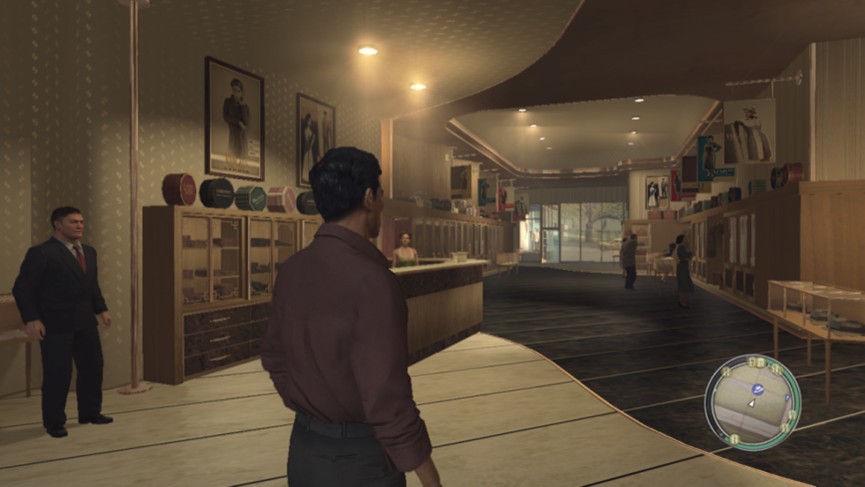
Figure 1. Clothing store from Mafia II (Image Courtesy: In-game screenshots from Mafia II)
3 | RESULTS AND DISCUSSION
To observe the representation of fashion in post-war mafia culture, screenshots of Vito Scaletta’s attire throughout the game were analysed. These attires were recommended for progressing through the chapters of the game to represent Vito’s status in the mafia family. After returning from World War 2, the very first attire worn by Vito is a leather jacket with a shirt and trousers. This attire is casual and acts as the default attire throughout the entire game. This attire represents Vito’s early life in the mafia business when he was not officially introduced into the mafia family and acted as an associate of the mafia family. This outfit was common attire for the young working class from post-war America (see Figure 2(A)) (Hendley, 2013; Lurigio & Binder, 2013; Montgomery, 1980). In the following screenshot, Vito is seen wearing a regular-fitting black shirt with a button-up collar. The shirt has a smooth visible texture with no distinguished pattern. The trousers are also a dark hue, providing an overall formal or semi-formal look (see Figure 2(B)). This attire is associated with Vito’s further involvement in the mafia family, representing the pursuit of the luxury of mafia culture. The following screenshots depict Vito’s fashion style as a ‘made man’ in the mafia family. After progressing to a certain point in the game, Vito is officially introduced into the mafia family. In the next screenshot, Vito is seen donning a black overcoat. The coat features a formal white shirt, indicating a formal or semi-formal outlook. The trousers and tie are also dark, complementing the attire’s overall dark colour scheme, as well as a fedora, which is a frequent item to complete a formal look with a vintage aesthetic (see Figure 2(C)). In the final screenshot, Vito is seen wearing a tailored, sharp suit, which is a hallmark of mafia culture in post-war America, representing their power and wealth. The tailored suit contains three pieces. The black suit is often associated with the mafia, representing their power and status in society. In addition, the grey colour waistcoat provides an elegant look, emphasising an imposing silhouette. The red tie with a geometric pattern acts as a contrast to the white shirt of the attire, providing a formal look as well as breaking the monochromatic palette. The additional fedora gives a vintage appeal, which precisely represents the luxurious lifestyle of the mafia families (see Figure 2(D)) (Hendley, 2013; Lombardo, 2012; Lurigio & Binder, 2013; Newhouse, 1993). The study observes a symbolism of colour in Vito’s choice of attire. Vito’s early brown leather jacket symbolised his early life before joining the mafia. The dominance of black in Vito’s later attires is associated with the power of authority, wealth, and rebellion of the mafia families (Pastoureau, 2009). Fabric and attire type are also related to Vito’s social standing. His early, low-ranking days are shown by a casual leather jacket, shirt, and pants, as was prevalent among post-war America's youthful working class. As he becomes a "made man," his clothes change to expensive, smooth-textured pieces with distinctive accessories like fedoras, which represent the mafia's opulent lifestyle, wealth, and power. The overcoat and fedora also add a vintage element to a formal outfit. The choice of selecting attire also gives the player an understanding of the perception of Vito’s wealth and power as the player progresses through the chapters.
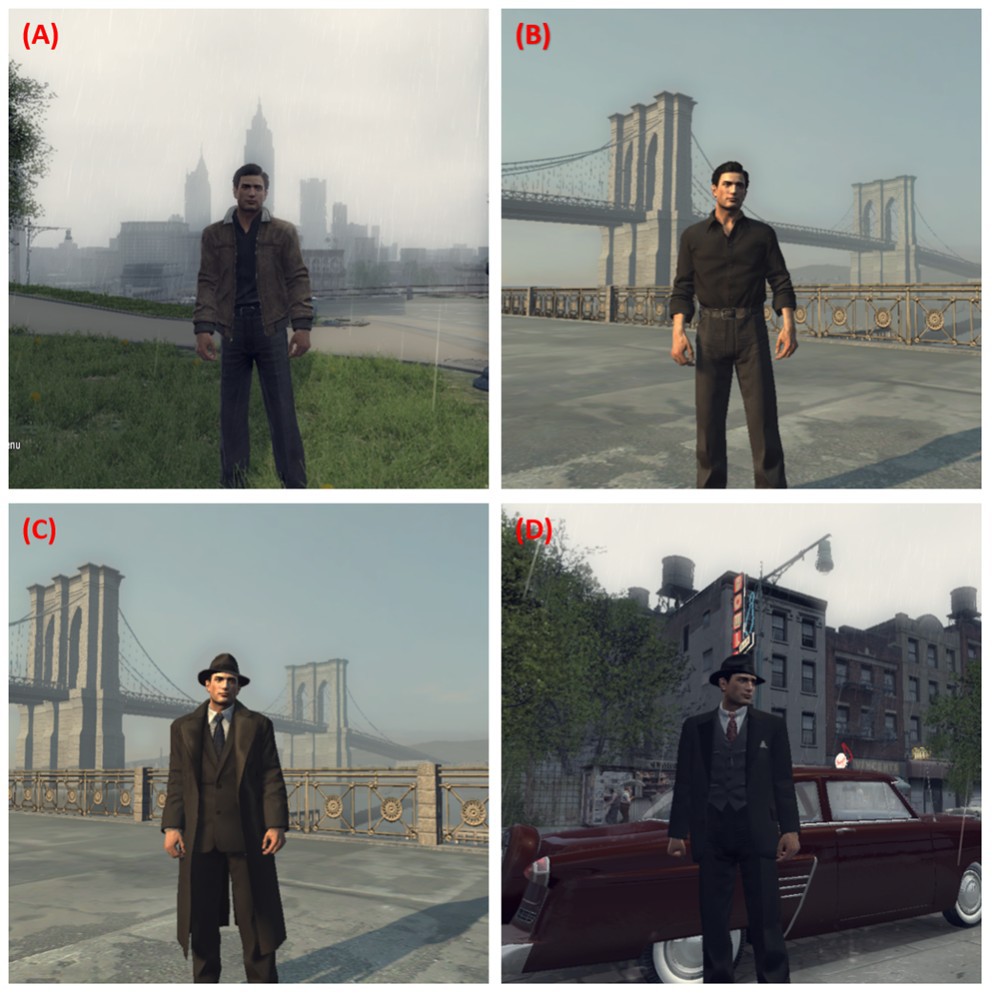
Figure 2. Attires of Vito Scaletta from Mafia II, (A) Leather jacket with shirt and trouser; (B) Shirts and trousers; (C) Expensive suits with overcoat; and (D) Tailored Suit (Image Courtesy: In-game screenshots from Mafia II)
4 | IMPLICATIONS OF FINDINGS
The findings of this study implicate a faithful representation of fashion in post-war mafia culture. Vito’s early attire as an associate of the mafia family represents low status in the mafia family. As Vito progresses and his rank in the mafia family goes higher, his attire becomes more sharp-fitting and refined, indicating the practice of mafia families’ luxurious lifestyle in post-war America. The more refined Vito’s attire becomes, the more they represent power and status in society, which is practical to the mafia’s practice in real life. This communication depicts Mafia II as a digital archive of post-war American subculture among the mafia, emphasising how video games can retain fleeting design trends. It offers a new viewpoint on how digital media enables users to act and internalise cultural identities, as well as how marginalised groups utilise fashion to resist, assimilate, and create myths. This communication converts Mafia II into a playable, interactive digital archive that both scholars and fashion designers may learn from. Furthermore, game developers can use real-world fashion trends to represent a character’s identity as well as archiving the subculture associated with that fashion digitally. The choice of attire selection offers players to experience an immersive environment, so a proper representation of a subcultural fashion is significant for game developers. By giving the players the freedom to visually express their character purchased from the in-game clothing store while maintaining the game’s historic accuracy, game developers allow digital archiving of the post-war American mafia fashion more effectively than any other media.
5 | LIMITATIONS OF THE STUDY
The study’s primary limitation is its focus on its protagonist, Vito Scaletta, which may introduce a potential bias from a single-protagonist focus. The analysis is based on a small number of screenshots chosen for their visibility and narrative significance. While this method clearly depicts Vito's personal development and the relationship between his clothing and his emerging status, it limits the study's capacity to present a comprehensive account of fashion in post-war America. It did not include other characters' attire, such as members from associate and rival mafia families, which has a substantial impact on hierarchy analysis because it limits the scope of comparison. The study only looks at the protagonist Vito Scaletta's clothing, which are encouraged for progressing through the game's chapters and expressing his rank. While Vito's attire changes provide useful information about his personal development, the lack of data from other characters means there is no direct visual baseline to compare his status against. Analysing the protagonist's clothing solely limits the study's ability to provide a comprehensive portrayal of fashion in post-war America. In terms of technical limitations, the visual data was collected using in-game screenshots. Hence, the proper details and textures of the attire are dependent on the quality and resolution of the screenshots. The analysis focused only on the protagonist due to “freedom of observation”, indicating the limitations of observing the attire of the non-playable characters (NPCs) for limited movement, visibility and camera angle. Also, attire from the protagonists of downloadable content (DLCs) was excluded as their attire did not provide further insight into the representation of fashion in mafia culture. Furthermore, the study is limited by a lack of quantitative content analysis to complement findings from qualitative analysis.
6 | CONCLUSION AND FUTURE STUDIES
The study comes to the conclusion that video games can effectively serve as a digital archive of post-war American subcultural fashion, allowing for an interactive exploration of how fashion acts as a form of expressing one’s status in society. It emphasises the role of mafia fashion, in which attires contribute to underprivileged origins to represent wealth and power. The gradual refinement of attires indicates Vito’s progress in the mafia family, as well as identifying Vito’s power and status throughout the game. The study also links broader subcultural studies by emphasising that subcultural fashion is a visual expression of authority, wealth, and identity. Ultimately, Video games play an important role in conveying these subcultural images to a wider audience, leading to imitation and the creation of new fashion trends.
DATA AVAILABILITY STATEMENT
Not applicable.
CONFLICT OF INTEREST STATEMENT
The authors declare there was no conflict of interest.
DECLARATION OF GENERATIVE AI AND AI-ASSISTED TECHNOLOGIES IN THE WRITING PROCESS
During the preparation of this work, the author(s) used Quiltbot and Grammarly in order to correct grammatical errors and refine language clarity. After using this tool/service, the author(s) reviewed and edited the content as needed and take(s) full responsibility for the content of the publication.
ORCID
Md. Nahid-Ull-Islam
 https://orcid.org/0009-0005-5464-2492
Shah Md. Maruf Hasan
-
https://orcid.org/0009-0001-4596-938X
REFERENCES
- Anderson, E. F., McLoughlin, L., Liarokapis, F., Peters, C., Petridis, P., & De Freitas, S. (2010). Developing serious games for cultural heritage: a state-of-the-art review. Virtual reality, 14, 255-275. | Google Scholar ↗
- Art-Sheep. (2023). Silk Suits and Street Power: The American Mafia’s Role in Fashion, Society, and Politics. Available at: https://art-sheep.com/silk-suits-and-street-power-the-american-mafias-role-in-fashion-society-and-politics/
- Balela, M. S., & Mundy, D. (2015). Analysing cultural heritage and its representation in video games. Proceedings of DiGRA 2015 Conference, https://doi.org/10.26503/dl.v2015i1.721 | Google Scholar ↗
- Barwick, J. (2012). Where have all the games gone? An exploratory study of digital game preservation [Doctoral Thesis, Loughborough University]. https://hdl.handle.net/2134/10222 | Google Scholar ↗
- Bourdieu, P. (2018). The forms of capital. In The sociology of economic life (3rd ed., pp. 78-92). Routledge. | Google Scholar ↗
- Cao, Z., Gao, H., Qu, X., Yang, M., & Yang, X. (2013). Fashion, Cooperation, and Social Interactions. PLOS ONE, 8(1), e49441. https://doi.org/10.1371/journal.pone.0049441 | Google Scholar ↗
- Cheng, K., & Cairns, P. A. (2005). Behaviour, realism and immersion in games. CHI'05 extended abstracts on Human factors in computing systems, Association for Computing Machinery, New York, USA. https://doi.org/10.1145/1056808.1056894 | Google Scholar ↗
- Cheng, L. (2024). Storytelling Cultural Heritage Through a Video Game: Conflict in the Kowloon Walled City in Hong Kong. I. Saloul, B. Baillie (eds.), In The Palgrave Encyclopedia of Cultural Heritage and Conflict (pp. 1-10). Springer. https://doi.org/10.1007/978-3-030-61493-5_139-1 | Google Scholar ↗
- Choi, K.H. (2022). 3D dynamic fashion design development using digital technology and its potential in online platforms. Fashion and Textiles, 9(1), 9. https://doi.org/10.1186/s40691-021-00286-1 | Google Scholar ↗
- Chung, S.H., & Yang, S.-H. (2002). A Study on Violation in Gangster Fashion. International Journal of Costume and Fashion, 2, 87-102. | Google Scholar ↗
- Cole, R. A. (2021). Unboxing age of empires: Paratexts and the experience of historical strategy games. In Paratextualizing games: Investigations on the paraphernalia and peripheries of play (pp. 97-130). Berlin: Transcript Verlag. https://doi.org/10.1515/9783839454213-005 | Google Scholar ↗
- De Stefano, G. (2007). An Offer We Can't Refuse: The Mafia in the Mind of America. Farrar, Straus and Giroux. | Google Scholar ↗
- Di Mascio, D. (2021). Architecture, Narrative and Interaction in the Cityscapes of the Assassin’s Creed Series. In: Lee, JH. (eds) A New Perspective of Cultural DNA. KAIST Research Series. Springer, Singapore https://doi.org/10.1007/978-981-15-7707-9_9 | Google Scholar ↗
- Entwistle, J. (2000). Fashion and the Fleshy Body: Dress as Embodied Practice. Fashion Theory, 4(3), 323-347. https://doi.org/10.2752/136270400778995471 | Google Scholar ↗
- Hani, U., Azzadina, I., Sianipar, C. P. M., Setyagung, E. H., & Ishii, T. (2012). Preserving Cultural Heritage through Creative Industry: A Lesson from Saung Angklung Udjo. Procedia Economics and Finance, 4, 193-200. https://doi.org/https://doi.org/10.1016/S2212-5671(12)00334-6 | Google Scholar ↗
- Hebdige, D. (2012). Introduction: Subculture and Style. In Subculture (pp. 1-4). Routledge. | Google Scholar ↗
- Helgeson, M. (2011). The Best Video Game Period Pieces. Game Informer. Available at: https://www.gameinformer.com/b/features/archive/2011/08/19/the-best-video-game-period-pieces.aspx
- Hendley, N. (2013). The Mafia: A Guide to an American Subculture (1st ed.). Bloomsbury Publishing. | Google Scholar ↗
- Huang, X. (2019). Understanding Bourdieu - Cultural Capital and Habitus. Review of European Studies, 11(3), 45-49. https://doi.org/10.5539/res.v11n3p45 | Google Scholar ↗
- Kelly, A. (2022). The Genius Of Mafia 2's Twin Time Periods. The Gamer. Available at: https://www.thegamer.com/the-genius-of-mafia-2s-twin-time-periods/#:~:text=The%20Genius%20Of%20Mafia%202's%20Twin%20Time%20Periods
- Laamarti, F., Eid, M., & El Saddik, A. (2014). An overview of serious games. International Journal of Computer Games Technology, 2014(1), 358152. https://doi.org/10.1155/2014/358152 | Google Scholar ↗
- Lombardo, R. M. (2012). Organized Crime in Chicago: Beyond the Mafia. University of Illinois Press. | Google Scholar ↗
- Lurigio, A. J., & Binder, J. J. (2013). The Chicago Outfit: Challenging the Myths About Organized Crime. Journal of Contemporary Criminal Justice, 29(2), 198-218. https://doi.org/10.1177/1043986213485656 | Google Scholar ↗
- Mafia II. Wikipedia. https://en.wikipedia.org/wiki/Mafia_II
- Malegiannaki, I., & Daradoumis, Τ. (2017). Analyzing the educational design, use and effect of spatial games for cultural heritage: A literature review. Computers & Education, 108, 1-10. https:/doi.org/10.1016/j.compedu.2017.01.007 | Google Scholar ↗
- Malegiannaki, I. A., Daradoumis, T., & Retalis, S. (2020). Teaching cultural heritage through a narrative-based game. Journal on Computing Cultural Heritage, 13(4), 1-28. https://doi.org/10.1145/3414833 | Google Scholar ↗
- Mol, A. A. A., Politopoulos, A., & Ariese-Vandemeulebroucke, C. E. (2017). “From the Stone Age to the Information Age”: History and Heritage in Sid Meier's Civilization VI. Advances in Archaeological Practice, 5(2), 214-219. https://doi.org/10.1017/aap.2017.9 | Google Scholar ↗
- Montgomery, D. (1980). To study the people: The American working class. Labor History, 21(4), 485-512. https://doi.org/10.1080/00236568008584594 | Google Scholar ↗
- Mortara, M., Catalano, C. E., Bellotti, F., Fiucci, G., Houry-Panchetti, M., & Petridis, P. (2014). Learning cultural heritage by serious games. Journal of Cultural Heritage, 15(3), 318-325. https:/doi.org/10.1016/j.culher.2013.04.004 | Google Scholar ↗
- Newhouse, T. E. (1993). Subcultures: the underground in American fiction, 1945-1970. State University of New York at Buffalo. | Google Scholar ↗
- Ott, M., & Pozzi, F. (2011). Towards a new era for Cultural Heritage Education: Discussing the role of ICT. Computers in Human Behavior, 27(4), 1365-1371. https:/doi.org/10.1016/j.chb.2010.07.031 |